About Coryphantha compacta (Engelm.) Britton & Rose
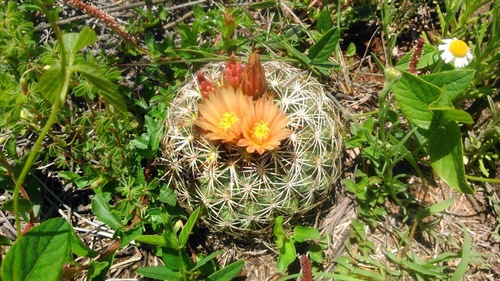
Coryphantha compacta typically, but not always, grows as a solitary plant. Its stems are globular, with a slight flattening at the top. Mature stems average just over 3 inches (8 cm) in diameter. The outer portion of the cactus body is divided into low tubercles that cluster together, resembling the shape of green chili pepper bottoms. Each tubercle bears a cluster of 11 to 16 slender spines that range in color from white to yellow, growing from specialized structures called areoles. Most of these spines radiate outward and lie close to the cactus surface, with their tips slightly overlapping the tips of adjacent spine clusters. The center of each spine cluster may or may not produce a central spine, which has a hooked tip like a cat's claw. Flowers are usually pale yellow, and measure only about 2 cm (around ¾ inch) long. Fruits are egg-shaped and orangish brown. Research-grade observations documented on the iNaturalist website place this species in the northwestern Mexican states of Chihuahua, Sonora, Sinaloa, and Durango. Coryphantha compacta grows mainly in desert and dry scrub habitats at elevations between 1400 and 2400 m (4600 to 7900 ft). Its typical habitat includes open sandy areas such as low hilltops, in soils of volcanic origin. Other cactus and succulent species that can be found growing alongside it in these locations are Cochemiea wrightii, Mammillaria heyderi, Erythrina americana, and Nolina texana.