About Corynocarpus laevigatus J.R.Forst. & G.Forst.
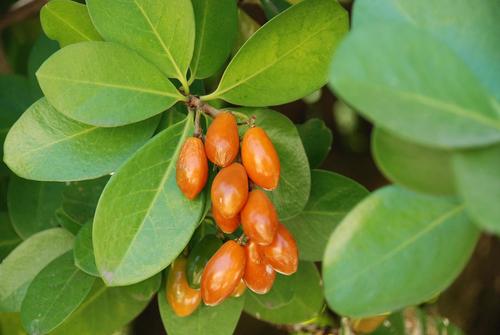
Corynocarpus laevigatus, commonly called karaka, is a medium-sized evergreen canopy tree with erect spreading branches, and it is endemic to New Zealand. It typically grows 15–20 metres (49–66 feet) tall, with a stout trunk usually up to 60 centimetres (24 inches) in diameter, though trunks can reach up to 1 metre (3 feet 3 inches) across; the largest diameter ever recorded for this species was 3 metres (10 feet). Mature trees have dark brown, corrugated bark, with corrugations forming broken pieces roughly 1 cm × 3 cm (0.4 in × 1.2 in) and 0.5 cm (0.2 in) thick. Bark is usually grey on mature trees, while younger trees have lighter brown bark that often features short horizontal bands that look like sewing stitches. Karaka is predominantly a coastal tree, though it also grows in lowland inland forests in New Zealand's North Island. It has an estimated maximum lifespan of 500 years in mainland New Zealand, with one specimen from Lady Alice Island potentially reaching 600 years of age. Karaka produces alternate, thick, leathery dark green leaves that are paler green underneath. Leaves are elliptic to oval, vaguely obovate (egg-shaped) to oblong (rectangular), growing up to 8 cm (3 in) wide, on petioles less than 2 cm (0.8 in) long. Flowering occurs between August and November. The species produces large, stout, erect panicles (flower clusters) up to 200 mm long, each holding 100–200 tiny greenish-yellow flowers that are less than 0.5 cm (0.2 in) in diameter. Its sepals are rounded, and its petals are vaguely spoon-shaped (spathulate). The oval fruits are 30–40 mm (1.2–1.6 in) long, with pale yellow to orange flesh and a smooth, elliptic poisonous seed. The seed has an open network of fibrous veins across its yellowish surface. The fruit has a sickly sweet taste similar to apricots or dates. Fruits typically ripen between January and April, and seeds are mostly dispersed by two native New Zealand columbiform birds: kererū (Hemiphaga novaeseelandiae) and the Chatham Islands pigeon (Hemiphaga chathamensis), which are the only native birds with a gape large enough to consume karaka fruits. The wood anatomy of Corynocarpus laevigatus makes it impossible to age specimens via the standard method of counting annual growth rings. Growth rates vary across individuals: specimens planted in Palmerston North in 1962 grew to 14 m (46 ft) tall in 42 years, with the largest stem diameter reaching 26.5 cm (10.4 in), for an average growth rate of 0.68 mm (0.027 in) per year. The largest known karaka tree in mainland New Zealand is 500 years old, with a diameter at breast height (DBH) of 212 cm (83 in), for an average growth rate of 0.43 cm (0.17 in) per year. Corynocarpus laevigatus has a diploid chromosome count of 46. The species is abundant across New Zealand's North Island and northern South Island, reaching as far south as Banks Peninsula on the South Island's east coast and Greymouth on the West Coast. It also occurs on the Chatham Islands, Kermadec Islands, and Three Kings Islands. It is likely that the species was restricted to the far north of the North Island before Polynesian arrival in New Zealand, and its current range across offshore islands and the northern half of the South Island came from spread after Māori plantings. Populations are often found near former pā (Māori village) sites. The species was not naturally present in the Otago and Southland Regions of New Zealand prior to human settlement, and all individuals south of Banks Peninsula are thought to be recent introductions. In Otago and Southland, karaka is naturally uncommon and grows only in scattered coastal locations. The entire South Island population is restricted to coastal areas, with most individuals concentrated around Banks Peninsula (including Christchurch's coastal areas) and the Marlborough Sounds. Corynocarpus laevigatus has been introduced to the United States. It is naturalised and classified as an invasive species in Hawaii, where it grows in wet soils and threatens endangered and rare native species. It was introduced to Hawaii for reforestation, first becoming naturalised on Kauai in 1891, and it remains common across that island today. It is primarily naturalised on Kauai, but also occurs on the islands of Hawaii, Molokai, and Oahu. The species is also found in Southern California. In its native New Zealand range, karaka fruits are a valuable food source for native birds. New Zealand bellbirds (Anthornis melanura) have been observed feeding on sap from karaka bark. Smaller native birds including the North Island robin (Petroica longipes), silvereye (Zosterops lateralis), and whiteheads (Mohoua albicilla) forage for insects around karaka trees. Polynesian rats (Rattus exulans) sometimes nibble karaka endocarps, while larger brown rats (Rattus norvegicus) may chew through endocarps. Both rat species consume the fruit flesh. Invasive brushtail possums in New Zealand also eat the flesh of karaka fruits. Extinct moa and other large birds likely consumed karaka fruits centuries ago. Karaka is a host tree for the endemic New Zealand beetle Oemona hirta. A 2016 study found that Corynocarpus laevigatus is one of New Zealand's least flammable tree species, with among the highest moisture contents and lowest flammability rates. In New Zealand, karaka has been connected to dog poisonings, which has led to calls to remove the species from urban areas. Corynocarpus laevigatus is common in cultivation and widely available for sale in New Zealand and around the world. It was one of the most important food crops grown by pre-European Māori, alongside kūmara and aruhe. Māori ate the drupe and seed after completing a long detoxification process. Karaka seeds contain the toxin karakin and other glucosides of 3-nitropropionic acid, which are highly toxic. Initial symptoms of poisoning include diarrhoea, nausea, and restlessness, which progress to more severe gastrointestinal and neurological problems. Each autumn, pre-colonisation Māori would collect seeds fallen from karaka trees. They placed the seeds in open-woven traditional baskets (kete), washed them to remove the outer pulp, then baked and sun-dried them, a process that eliminated the seed toxicity.

