About Corymbia trachyphloia (F.Muell.) K.D.Hill & L.A.S.Johnson
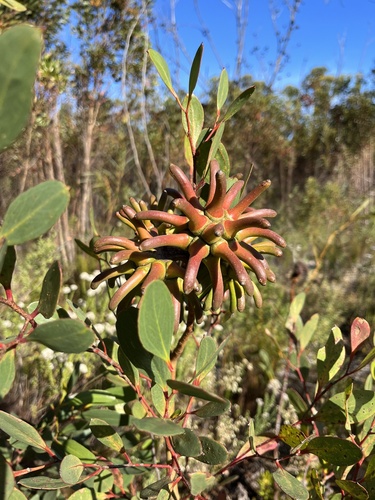
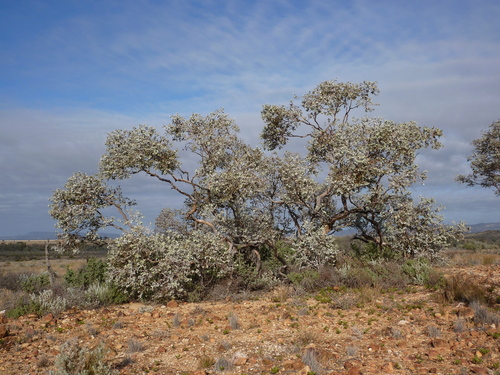
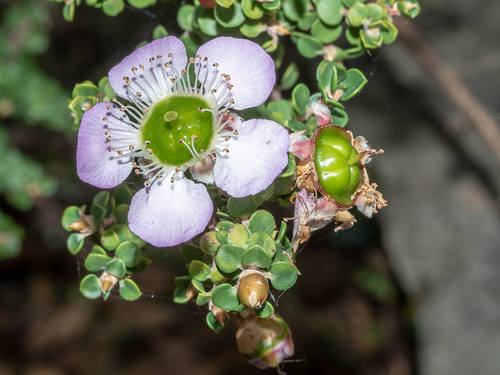
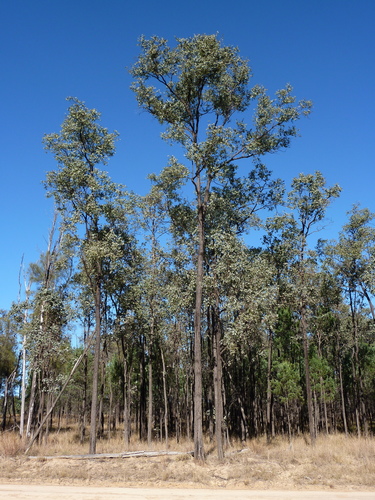
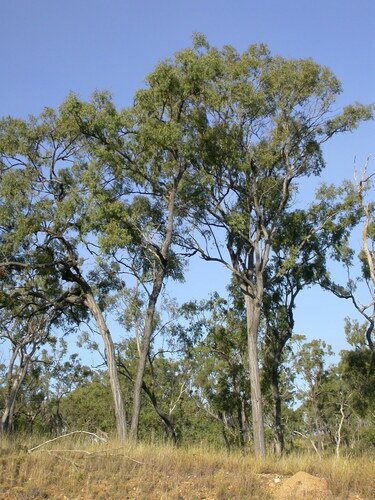
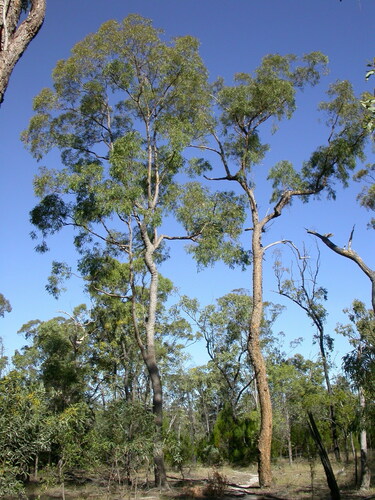
Corymbia trachyphloia (F.Muell.) K.D.Hill & L.A.S.Johnson is a tree species that typically grows to a height of 15 m (49 ft) and forms a lignotuber. It has rough, brown and greyish bark covering its trunk, and often also covers its larger branches. Young plants and coppice regrowth have lance-shaped, glossy green leaves that are paler on the lower surface. These leaves are 50–120 mm (2.0–4.7 in) long, 10–35 mm (0.39–1.38 in) wide, petiolate, with the petiole attached to the underside of the leaf blade. Adult leaves are usually glossy dark green, paler on the lower surface, and narrow lance-shaped to lance-shaped. They measure 65–140 mm (2.6–5.5 in) long and 9–26 mm (0.35–1.02 in) wide, tapering to a petiole 8–20 mm (0.31–0.79 in) long. Flower buds are arranged on a branched peduncle 4–13 mm (0.16–0.51 in) long; each branch of the peduncle holds seven buds on pedicels 2–7 mm (0.079–0.276 in) long. Mature buds are pear-shaped, 4–5 mm (0.16–0.20 in) long and 2–4 mm (0.079–0.157 in) wide, with a rounded operculum. Flowering occurs from December to June, and the flowers are white. The fruit is a thin-walled, urn-shaped capsule 6–10 mm (0.24–0.39 in) long and 5–8 mm (0.20–0.31 in) wide, with the valves enclosed inside the fruit. This species usually grows in sandy soils on plains and sandstone outcrops, ranging from the Goulburn River in New South Wales north to the Blackdown Tableland, Carnarvon Range and Atherton Tableland in Queensland.