About Corymbia torelliana (F.Muell.) K.D.Hill & L.A.S.Johnson
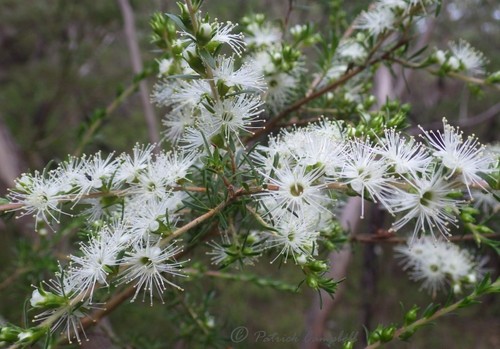
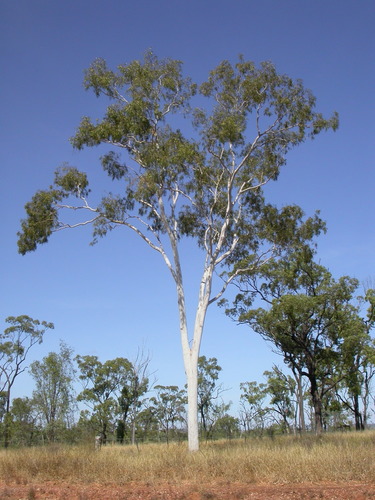
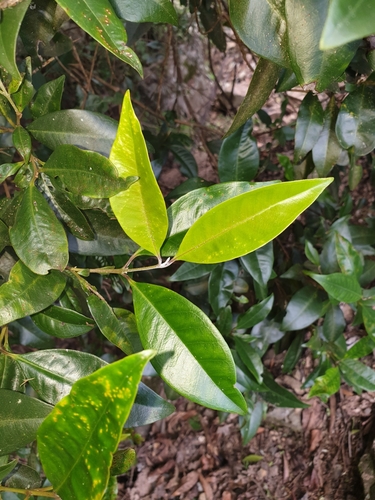
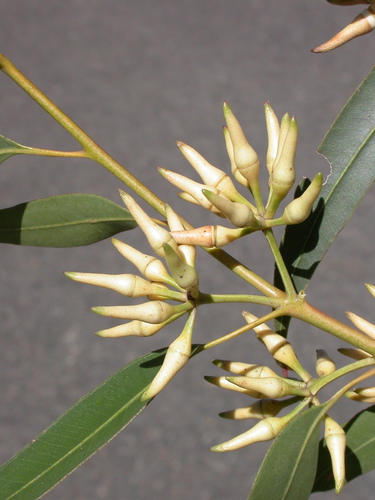
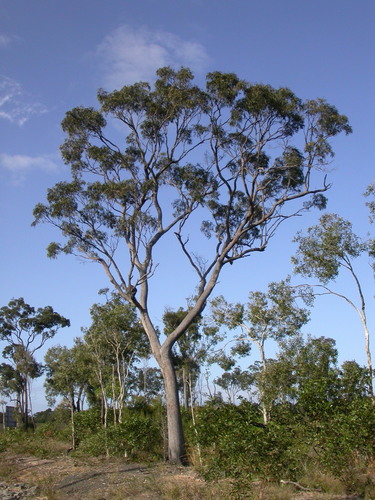
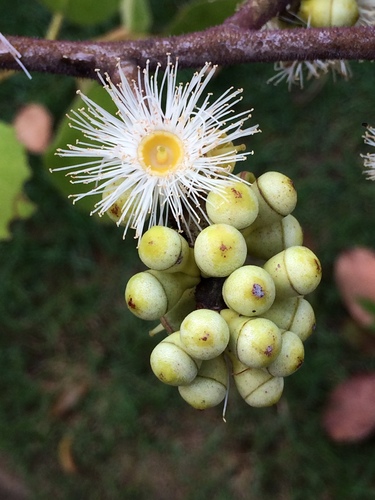
Corymbia torelliana typically reaches a height of 25 to 30 metres (82 to 98 ft) and forms a lignotuber. It has smooth greenish grey to white bark, though older individuals often have rough, tessellated greyish bark on the lower portion of the trunk. Young plants and coppice regrowth have glossy green heart-shaped, egg-shaped, or elliptical leaves, paler on the lower surface, measuring 90–145 mm (3.5–5.7 in) long and 60–105 mm (2.4–4.1 in) wide. Adult leaves are alternately arranged, paler on the lower surface, and can be egg-shaped, heart-shaped, or lance-shaped. They measure 60–160 mm (2.4–6.3 in) long, 15–85 mm (0.59–3.35 in) wide, and grow on a 10–24 mm (0.39–0.94 in) long petiole. Many small oil dots are visible on the leaves to the naked eye. Flower buds are arranged at the ends of branchlets on a branched peduncle 5–24 mm (0.20–0.94 in) long. Each branch of the peduncle holds three or seven buds, which are either sessile or on pedicels up to 5 mm (0.20 in) long. Mature buds are oval, 7–8 mm (0.28–0.31 in) long and 5–7 mm (0.20–0.28 in) wide, with a rounded, conical, or slightly beaked operculum. Flowering occurs from August to November, and the flowers are white. The fruit is a woody urn-shaped or shortened spherical capsule that is 9–14 mm (0.35–0.55 in) long and 8–14 mm (0.31–0.55 in) wide, with the valves enclosed inside the capsule. This species grows in wet sclerophyll forest, along rainforest margins, and as an emergent tree within rainforest. Its native natural range extends from Cooktown to Ingham, and inland as far as the Windsor Tablelands. It has been planted as a fast-growing tree for gardens and landscaping, and has become established beyond its original natural distribution. Commonly called cadaghi, this species has become naturalised outside its native range in south-eastern and central Queensland. It is classified as a weed in south-eastern Queensland, where it grows on roadsides, waterways, disturbed sites, and waste areas. Its dense canopy often suppresses the growth of understorey species, altering the composition of native forests in subtropical regions. Native stingless bees Tetragonula carbonaria collect the sticky resin produced by this species' fruiting capsules; the resin clogs the bees' honeycombs, and can sometimes seal hive entrances and kill the bees inside. In horticulture, cadaghi is a fast-growing tree that has been used as a street and garden tree in areas further south than its natural range, including the inland towns of Narrabri, Chinchilla, and Cunnamulla. Its dense canopy of large leaves can provide ample shade in these locations. A sooty fungus that frequently grows on this tree can discolour objects placed under it. Large branches may occasionally break off, and the species causes serious environmental problems in coastal and near-coastal areas. Less invasive alternative trees for horticultural use include brush box (Lophostemon confertus), Moreton Bay ash (Corymbia tessellaris), and Queensland maple (Flindersia brayleyana).