About Corymbia tessellaris (F.Muell.) K.D.Hill & L.A.S.Johnson
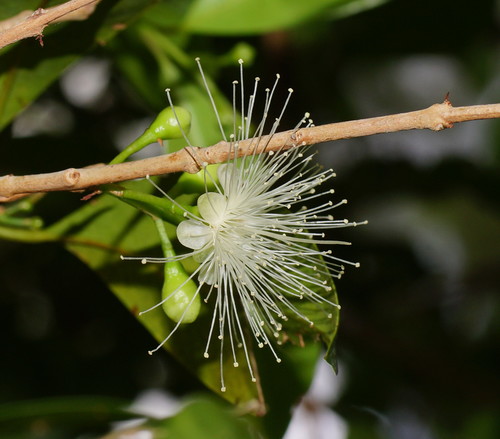
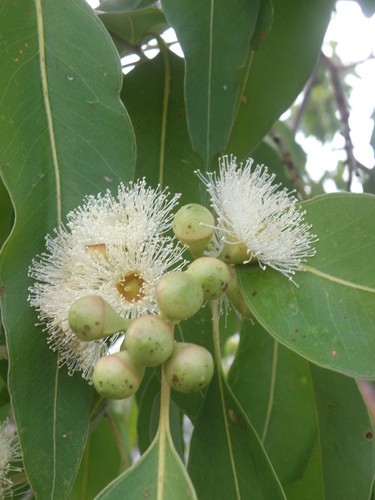
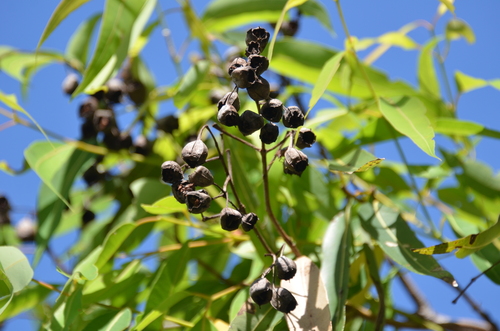
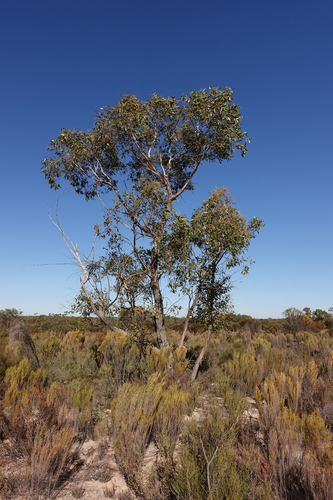
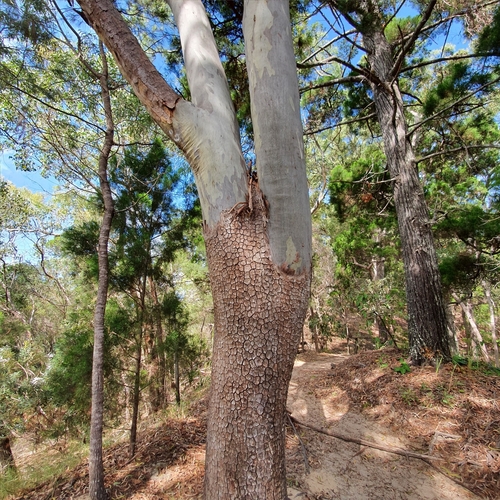
Corymbia tessellaris (F.Muell.) K.D.Hill & L.A.S.Johnson is an Australian tree species commonly known as carbeen. This tree typically grows to a height of 30–35 m (98–115 ft) and forms a lignotuber. Its trunk is almost always straight, making up half to two thirds of the tree's total height, and supports a crown of slender branches. The lower 1–4 m (3 ft 3 in – 13 ft 1 in) of the trunk is covered in rough, tessellated greyish bark, which changes abruptly to smooth whitish bark on the upper trunk and branches. Young plants and coppice regrowth have lance-shaped leaves that are arranged in opposite pairs when young. These leaves are 55–110 mm (2.2–4.3 in) long and 10–20 mm (0.4–0.8 in) wide, tapering to a short petiole, or are sometimes sessile. Adult leaves are arranged alternately, are the same shade of green to greyish on both sides, and are narrow lance-shaped to linear. They are 90–240 mm (3.5–9.4 in) long and 6–25 mm (0.24–0.98 in) wide, borne on a 5–15 mm (0.2–0.6 in) long petiole. Flower buds are arranged at the ends of branchlets on a branched peduncle 2–7 mm (0.08–0.28 in) long. Each branch of the peduncle holds three or seven buds, each on a pedicel 1–4 mm (0.04–0.16 in) long. Mature buds are oval to pear-shaped, 4–6 mm (0.16–0.24 in) long and 3–5 mm (0.12–0.20 in) wide, with a rounded operculum that often has a small point at the tip. Flowering mainly occurs between October and January, and the flowers are white. The fruit is a thin-walled cylindrical or urn-shaped capsule, 6–12 mm (0.24–0.47 in) long and 6–10 mm (0.24–0.39 in) wide, borne on a pedicel 1–3 mm (0.04–0.12 in) long, with its valves enclosed inside the capsule. Corymbia tessellaris is widespread in north-eastern Australia, where it grows in undulating open forest and woodland. It occurs from Cape York Peninsula south through eastern Queensland to near Narrabri and Kyogle in northern New South Wales, and is also found on some Torres Strait Islands and in southern New Guinea. Yirrganydji and Djabugay Indigenous people use medicine made from this tree to treat wounds and conditions such as dysentery, and use its wood to make tools. Carbeen is resistant to strong winds, heat and drought, and can be propagated from seed for horticultural use. The wood of this tree is heavy, and has been used for bridge construction and for making spears. The tree produces many organic compounds with industrial potential, including pinenes, aromadendrene, limonene and globulol.