About Corymbia terminalis (F.Muell.) K.D.Hill & L.A.S.Johnson
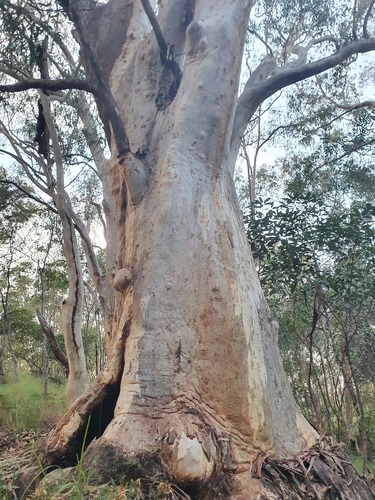
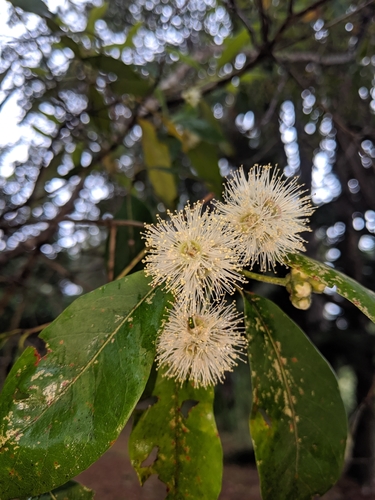
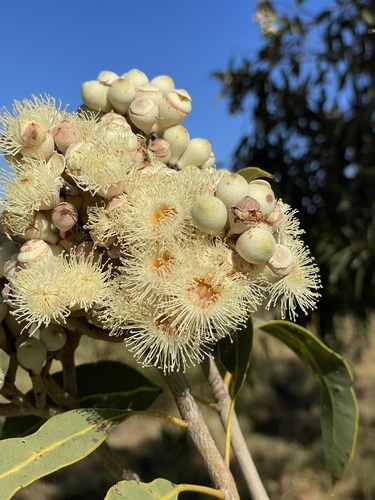
Corymbia terminalis is most commonly a tree that typically reaches 18 metres (59 ft) in height, and rarely grows as a mallee. It forms a lignotuber. It has rough, tessellated bark ranging from light brown to light grey that covers part or all of the trunk, and sometimes extends to the tree’s larger branches. Young plants and coppice regrowth have leaves that are egg-shaped to elliptical or lance-shaped, 60–170 mm (2.4–6.7 in) long, 12–45 mm (0.47–1.77 in) wide. These young leaves taper to a petiole and are arranged in opposite pairs. Adult leaves are arranged alternately, are the same shade of grey-green on both surfaces, and are lance-shaped. They measure 80–200 mm (3.1–7.9 in) long and 12–30 mm (0.47–1.18 in) wide, and grow on a petiole 10–30 mm (0.39–1.18 in) long. Flower buds are arranged at the ends of branchlets, growing on a branched peduncle 5–20 mm (0.20–0.79 in) long. Each branch of the peduncle holds seven buds, each on an individual pedicel 2–13 mm (0.079–0.512 in) long. Mature buds are scurfy, oval to pear-shaped, and range in color from greenish to brown or cream-coloured. They are 6–14 mm (0.24–0.55 in) long and 5–10 mm (0.20–0.39 in) wide, with a conical, rounded or flattened operculum. Flowering occurs between March and October, and the flowers are white. The fruit is a woody urn-shaped capsule 15–31 mm (0.59–1.22 in) long and 12–22 mm (0.47–0.87 in) wide, growing on a pedicel 2–12 mm (0.079–0.472 in) long. The fruit’s valves are enclosed within the capsule. The seeds are light brown or reddish brown, 9–12 mm (0.35–0.47 in) long, with a wing at one end. This eucalypt grows in arid and seasonally dry areas of the Northern Territory, Queensland, north-western New South Wales, and the extreme north of South Australia. Corymbia opaca, which is sometimes included within C. terminalis, is found in the northern half of Western Australia. This tree typically grows on river flats, scree slopes and dune swales. It prefers well-drained soils, and is tolerant of both drought and frost. The flowers of Corymbia terminalis produce nectar drops that are a high-energy food source for many desert animals, including honeyeaters, insects and possums. It also acts as a host for an unusual female insect called a coccid. After the coccid burrows into the tree’s bark, it forms a gall that it never leaves, and stays hidden inside to suck sap from the tree’s vascular tissues. The gall that grows on the tree is referred to as the coconut. It has to be broken open to access the insect inside; the insect is edible, contains a large amount of moisture, and acts as a disinfectant. Indigenous Australians have used this tree for traditional medicine. Exudate from the trunk or branches was diluted and used as an antiseptic to treat facial cuts and sores. Larger leaves were used to staunch wounds. Red bark kino can be stripped from the tree, mixed in water, and consumed to treat diarrhoea, indigestion, and chest pain. Indigenous peoples used the tree’s wood to make spear-throwers, digging bowls, and carrying vessels. Europeans used the wood for fence-posts, joists, slabs, buildings, and as firewood.