About Corymbia maculata (Hook.) K.D.Hill & L.A.S.Johnson
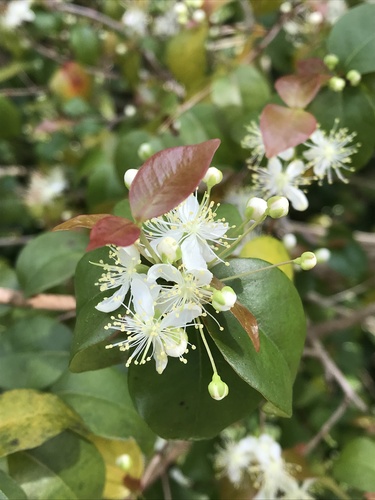
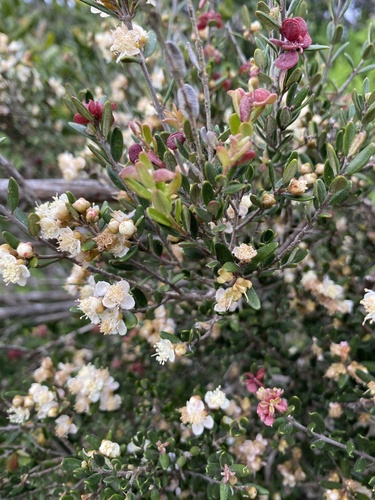
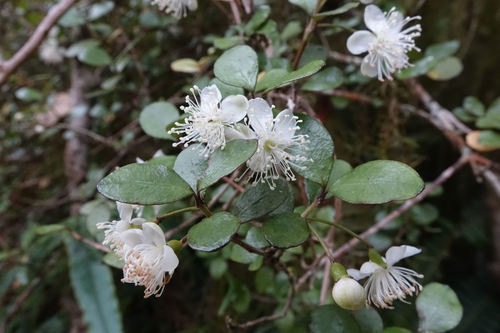
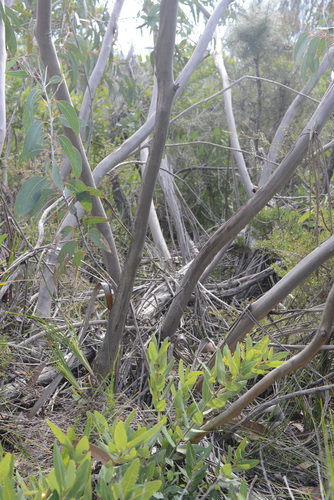
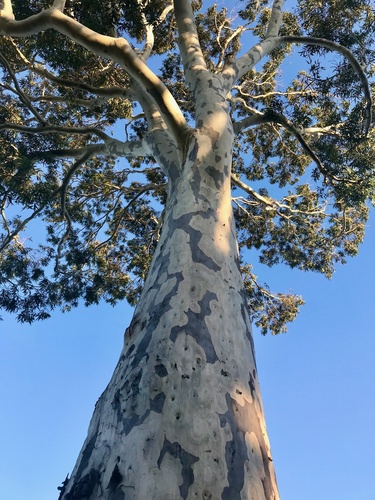
Corymbia maculata (Hook.) K.D.Hill & L.A.S.Johnson is a tree that typically reaches a height of 45–60 m (148–197 ft) and forms a lignotuber. It has smooth, mottled pinkish grey or bluish grey bark that is often dimpled and sheds in small, irregular flakes. Leaves on young plants and coppice regrowth are glossy green, broadly egg-shaped to lance-shaped, 70–190 mm (2.8–7.5 in) long, 30–75 mm (1.2–3.0 in) wide, and grow on a petiole. Adult leaves are the same shade of green on both sides, lance-shaped or curved, 80–210 mm (3.1–8.3 in) long, 12–30 mm (0.5–1.2 in) wide, and taper to a 10–25 mm (0.4–1.0 in) long petiole. Flower buds are arranged in leaf axils on a branched peduncle 3–20 mm (0.12–0.79 in) long. Each branch of the peduncle holds three, rarely seven, buds on pedicels 1–8 mm (0.04–0.31 in) long. Mature buds are oval to pear-shaped, 8–10 mm (0.31–0.39 in) long and 6–8 mm (0.24–0.31 in) wide, with a hemispherical, conical or beaked operculum that is shorter than the floral cup. Flowering occurs from March to September, and the flowers are white. The fruit is a woody oval, barrel-shaped or slightly urn-shaped capsule 9–14 mm (0.35–0.55 in) long and 8–13 mm (0.31–0.51 in) wide, with valves enclosed inside the fruit. Corymbia citriodora and C. henryi are similar to C. maculata, but they have a more northerly distribution that extends into Queensland. Adult leaves of C. citriodora are slightly narrower than those of C. maculata, while adult leaves of C. henryi are wider than those of C. maculata. Corymbia maculata is a widespread species that grows in open forest from near Bega north along the New South Wales coast to near Taree. There is a disjunct population near Orbost in Victoria. It often forms dense, pure stands in forest and commonly grows on moderately infertile soil. The species is naturalised in Western Australia and South Australia, as well as in areas of New South Wales and Victoria outside its original natural range. In ecology, the flowers of this species attract honeyeaters. In horticulture, spotted gum is often used for planting in parks and as a street tree, but its large mature size makes it unsuitable for most home gardens.