About Corymbia intermedia (R.T.Baker) K.D.Hill & L.A.S.Johnson
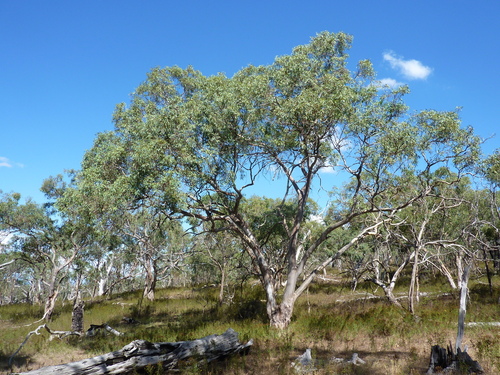
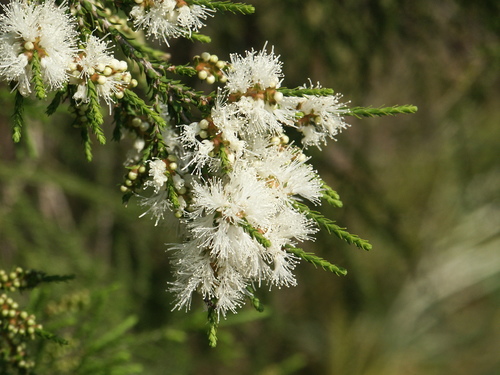
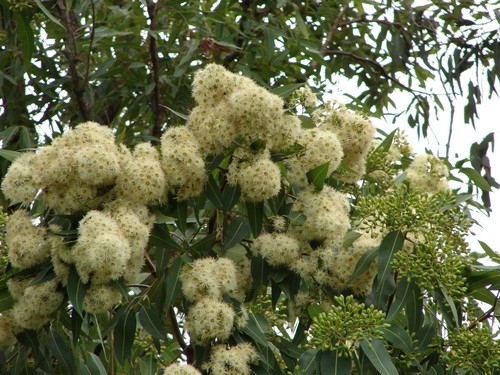
Corymbia intermedia, commonly known as pink bloodwood, is a tree that reaches 20–30 m (65–100 ft) in height, with a 10–20 m (35–65 ft) spread. Its rough, tessellated bark ranges from light brown to grey, and extends from the trunk all the way to the branches. Young plants and coppice regrowth have lance-shaped, dark green leaves that are paler on the lower surface. These leaves are 80–160 mm (3.1–6.3 in) long, 20–42 mm (0.79–1.65 in) wide, and have a petiole. Adult leaves are arranged alternately, are leathery, paler on the lower surface, and lance-shaped. They measure 80–150 mm (3.1–5.9 in) long, 13–40 mm (0.51–1.57 in) wide, and grow on a petiole 12–25 mm (0.47–0.98 in) long. Flower buds grow at the ends of branchlets on a branched peduncle 10–20 mm (0.39–0.79 in) long, with seven buds per peduncle branch on pedicels 2–15 mm (0.079–0.591 in) long. Mature buds are pear-shaped to oval, 7–10 mm (0.28–0.39 in) long and 4–6 mm (0.16–0.24 in) wide, with a conical, rounded, or beaked operculum. Flowering occurs from December to March, producing profuse, perfumed white or cream flowers that reach up to 20 mm (0.79 in) in diameter. The fruit is an urn-shaped, oval, or barrel-shaped capsule 10–20 mm (0.39–0.79 in) long and 8–16 mm (0.31–0.63 in) wide, with a short neck and valves enclosed inside the fruit. Pink bloodwood resembles red bloodwood, and the two species grow together in central New South Wales. Red bloodwood can be distinguished from pink bloodwood by its larger gumnuts and winged seeds. This species occurs in New South Wales from Gloucester northwards into Queensland, reaching as far north as Cape York. Its total range spans roughly 2,500 km (1,600 mi), and all populations grow within 100 km (62 mi) of the eastern Australian coastline. Pink bloodwood grows best on loamy and sandy soils, and has been recorded at altitudes up to 1,200 metres (3,900 feet). It occupies areas with annual rainfall between 750–2200 mm, where rainfall falls predominantly in summer. It typically grows in open forest, and occasionally grows as isolated individual trees in closed forest or on rainforest margins. In coastal north Queensland, it is associated with species including Corymbia tesselaris (carbeen), Eucalyptus caliginosa (broad-leaved stringybark), E. tereticornis (forest red gum), E. crebra (narrow-leaved ironbark), E. racemosa (scribbly gum), E. propinqua (grey gum), E. pilularis (blackbutt), E. grandis (flooded gum), E. resinifera (red mahogany), Allocasuarina littoralis (black sheoak), and Acacia flavescens (red wattle). In Bungawalbin National Park in northern New South Wales, squirrel gliders (Petaurus norfolcensis) have been observed biting and gouging wounds into pink bloodwood trunk bark, then licking the sap from the wounds. This feeding behaviour has also been recorded for yellow-bellied gliders (Petaurus australis) feeding on this species. A study of forest habitats for sugar gliders (Petaurus breviceps) and mahogany gliders (Petaurus gracilis) found that the presence of pink bloodwood correlates with the presence of sugar gliders and the absence of mahogany gliders. A study of the effects of periodic burning in forests of southeastern Queensland found no significant difference in the trunk diameter of pink bloodwoods growing in unburnt forest compared to forests burnt every two or four years. The dark pink to reddish-brown heartwood of pink bloodwood is hard and durable, and is used for constructing fences and bridges. Pink bloodwood sawdust is an irritant to human eyes and skin. Corymbia intermedia may also be used as a rootstock for grafting the ornamental species Corymbia ficifolia.