About Corymbia gummifera (Gaertn.) K.D.Hill & L.A.S.Johnson
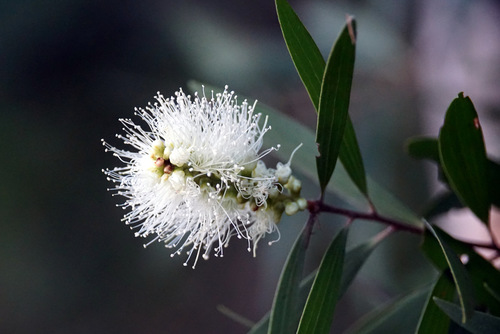
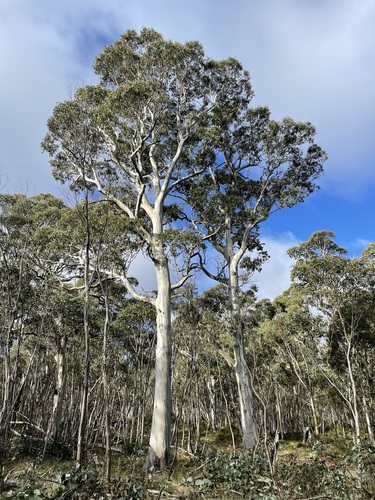
Corymbia gummifera is most commonly a tree that typically reaches a height of 20 to 35 metres (66 to 115 feet), and rarely grows as a mallee form. All forms of this species produce a lignotuber. When growing as a mallee, the lignotuber is not thick, measuring only 10 to 20 centimetres (3.9 to 7.9 inches) from top to bottom, but can reach up to 11 metres (36 feet) wide. Leaves of young plants and coppice regrowth have a paler lower surface, are egg-shaped to lance-shaped, 90 to 165 millimetres (3.5 to 6.5 inches) long, 30 to 52 millimetres (1.2 to 2.0 inches) wide, and grow on a petiole. Juvenile leaves are arranged opposite each other on the stem for the first few pairs, then become disjunct. Adult leaves are glossy dark green with a paler lower surface, lance-shaped, 55 to 160 millimetres (2.2 to 6.3 inches) long, 15 to 50 millimetres (0.6 to 2.0 inches) wide, and taper to a petiole 8 to 23 millimetres (0.3 to 0.9 inches) long. Flower buds are arranged in corymbs at the ends of branchlets, on a branched peduncle 17 to 33 millimetres (0.7 to 1.3 inches) long. Each branch of the peduncle holds seven buds, each on a pedicel 2 to 15 millimetres (0.08 to 0.59 inches) long. Mature buds are oval to pear-shaped, 8 to 12 millimetres (0.31 to 0.47 inches) long and 4 to 6 millimetres (0.16 to 0.24 inches) wide, with a conical, rounded, or slightly beaked operculum. Flowering happens between December and June, and the flowers are creamy white. The fruit is a woody urn-shaped capsule 12 to 22 millimetres (0.47 to 0.87 inches) long and 9 to 18 millimetres (0.35 to 0.71 inches) wide, with valves deeply enclosed within the fruit. Corymbia gummifera occurs mostly on coastal flats and low hills between the extreme eastern corner of Victoria and south-eastern Queensland. It grows best in moist, rich, loamy soil, but is also commonly found on poorer sandy soils. The heartwood of C. gummifera is very strong and durable, but contains extensive gum lines. It is used for rough construction purposes, including poles, sleepers, fencing, and mining timbers. C. gummifera may also be used as a rootstock for grafting the ornamental species Corymbia ficifolia.