About Corymbia ficifolia (F.Muell.) K.D.Hill & L.A.S.Johnson
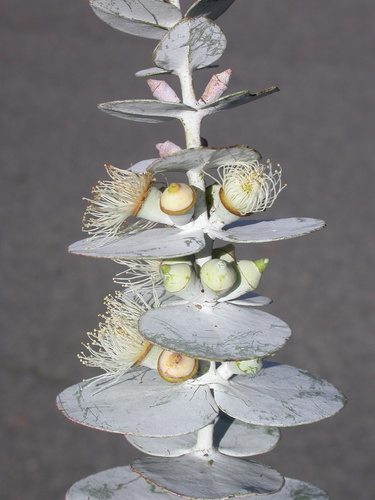
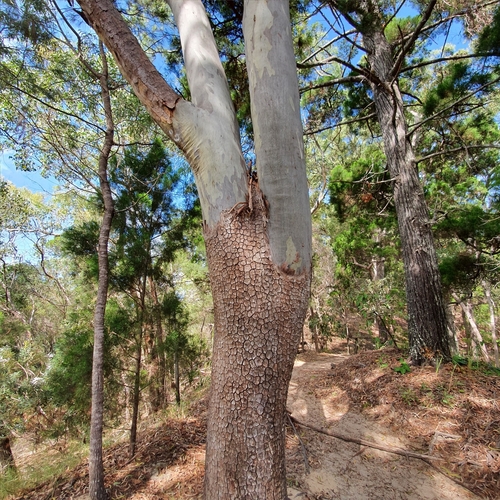
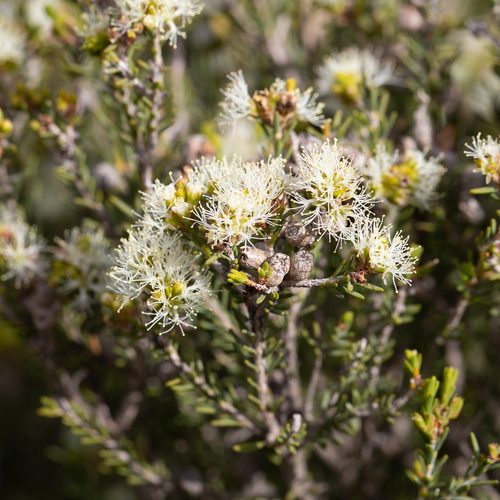
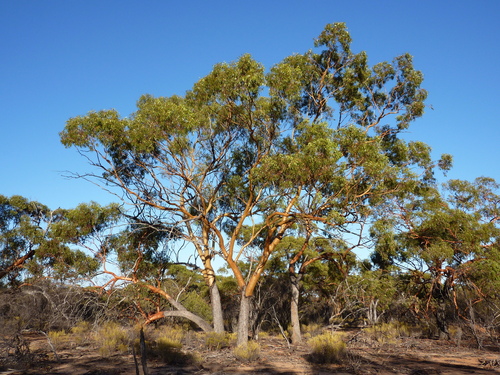
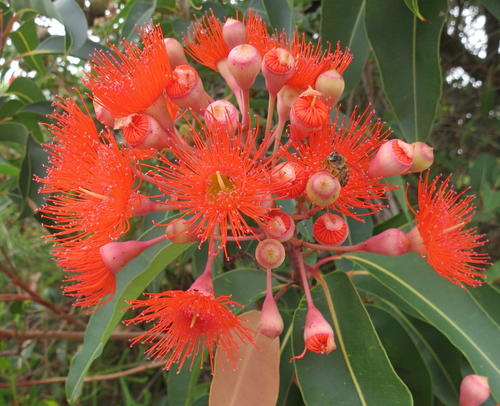
Corymbia ficifolia (F.Muell.) K.D.Hill & L.A.S.Johnson is a straggly tree that typically reaches 10 m (33 ft) in height and forms a lignotuber. Its trunk and branches are covered in rough, fibrous, brownish bark. Adult leaves are dull to slightly glossy, paler on the lower surface, and range from egg-shaped to broadly lance-shaped. They measure 70–130 mm (2.8–5.1 in) long and 25–50 mm (1.0–2.0 in) wide, tapering to a petiole 8–20 mm (0.3–0.8 in) long. Flower buds are arranged at the ends of branchlets on a branched peduncle 15–32 mm (0.6–1.3 in) long. Each branch of the peduncle holds seven buds, each on a pedicel 13–27 mm (0.5–1.1 in) long. Mature buds are oval to pear-shaped, 12–18 mm (0.5–0.7 in) long and 6–8 mm (0.24–0.31 in) wide, with a rounded to flattened operculum. Flowering occurs from December to May, and the flowers are bright red to pink to orange. The fruit is a woody urn-shaped capsule 20–42 mm (0.8–1.7 in) long and 18–30 mm (0.7–1.2 in) wide, with the valves enclosed inside the fruit. The two other bloodwoods found in the south-west of Western Australia are C. haemotoxylon and marri (C. calophylla). Unlike C. ficifolia, these species have tessellated bark instead of fibrous bark. Corymbia ficifolia grows in sandy soil in low forest on slopes, and is restricted to a sub-coastal distribution south-east of Perth, east of Mount Frankland, Walpole and the Stirling Range. Commonly called red-flowering gum, this species is one of the most widely cultivated of all eucalypts, both in Australia and overseas. It grows best in temperate districts with low summer rainfall, and is rarely reliable on the east coast of Australia. In suitable climates it is moderately fast-growing, and often grows larger and more vigorously in cultivation than it does in the wild. Eucalypts are difficult to grow from cuttings, so they are usually grown from seed. As a result, flower colour cannot be guaranteed, although some small forms are available as grafted plants. In nature, Corymbia ficifolia prefers infertile, sandy soils, but it adapts readily to most temperate locations, as long as it is not exposed to severe frost or sustained tropical damp. It is an ideal street tree because it is hardy, moderately fast growing, and rarely grows large enough to require pruning. The largest known single-stemmed tree of this species in the world, with a 216.5 cm diameter, is located on Princes Street in Hamilton, New Zealand. Because of its large, attractive colourful flowers, genetic improvement work for cold resistance in the Dublin area of Ireland is being carried out by collecting seeds from the coldest parts of Western and Southern Australia where the species grows. Most plants of this species in Ireland were killed by severe frosts, but the surviving shoots have been kept through tissue culture.