About Corymbia eximia (Schauer) K.D.Hill & L.A.S.Johnson
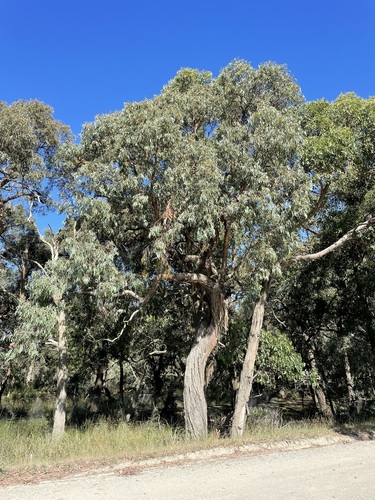
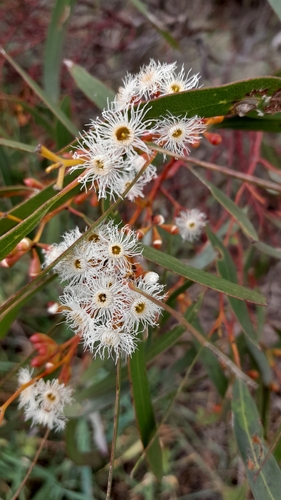
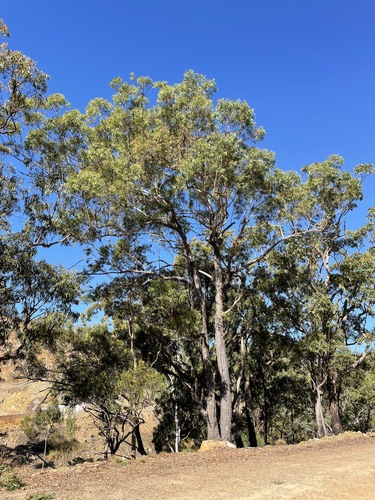
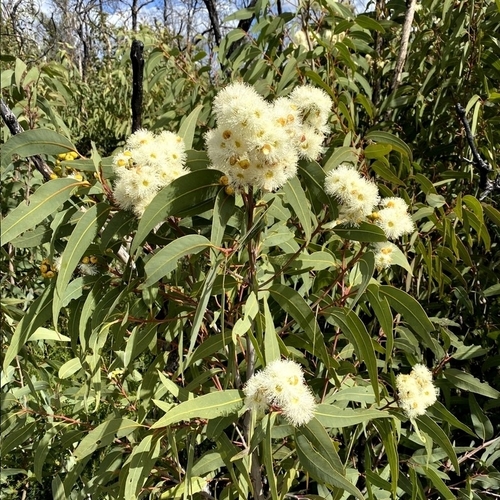
Corymbia eximia, commonly known as yellow bloodwood, is an attractive gnarled tree that grows up to 20 metres (70 feet) tall. When growing on an exposed site, it may develop a stunted, multistemmed growth habit. Its distinctive bark is yellowish fawn in color, with a rough, flaky texture and a somewhat tessellated pattern. Adult leaves are greyish green, thick, veiny, and measure up to 20 cm (8 in) long and 2.5 cm (1 in) wide. They are lanceolate (spear-shaped) or falcate (sickle-shaped), arranged alternately along stems, and the same color on both leaf surfaces. They also feature a prominent raised yellow midrib and taper toward the tip. Cream-colored flowers develop from buds formed in February, and bloom from August to October. These flowers are sometimes used in floral arrangements, and grow in groups of seven arranged in panicles. The flower buds are borne on short stalks (pedicellate), are pear- or club-shaped, and measure 1.3 to 1.5 cm (0.51 to 0.59 in) long by 0.6 cm (0.24 in) wide when young. The species produces urn-shaped gumnuts, the typical fruit shape of most bloodwoods. The wingless seeds mature by December and can remain on the tree for up to 16 months. Seedlings produce opposite leaves for their first three to six pairs; these early leaves are elliptic to lanceolate in shape. They are followed by oblong to lanceolate juvenile leaves, which become alternately arranged along stems. Juvenile leaves are light blue-green, and measure 7.5 to 12.5 cm (3.0 to 4.9 in) long by 2.5–3.2 cm (1.0–1.3 in) wide. This species is found in central New South Wales, Australia, ranging from Howes Valley in the north to Tolwong in the south. It is common around the Sydney Basin, where it grows on sandstone plateaux and escarpments near the Nepean and Hawkesbury Rivers, and in the lower Blue Mountains, most often on the western aspects of slopes. It occurs at altitudes up to 500 metres, in regions with annual rainfall between 730 and 1800 mm. It grows in dry sclerophyll forest on sandstone soils, where it associates with a range of other species including Corymbia gummifera (red bloodwood), Angophora hispida (dwarf apple), Angophora costata (smooth-barked apple), Eucalyptus sparsifolia (narrow-leaved stringybark), Eucalyptus globoidea (white stringybark), Eucalyptus piperita (Sydney peppermint), Eucalyptus punctata (grey gum), Eucalyptus haemastoma and Eucalyptus racemosa (scribbly gums), and Allocasuarina littoralis (black sheoak). After bushfire, yellow bloodwood regenerates by regrowing from epicormic buds. Individual trees can live for over a hundred years. The grey-headed flying fox (Pteropus poliocephalus) feeds on its flowers, and the species is highly sensitive to white leaf and shoot blight caused by Sporothrix pitereka. Due to its relatively small size and relative rarity, Corymbia eximia was rarely used as timber. It has been planted as a street tree in Australian cities, and its small size and attractive bark make it suitable for backyards, though it grows too large for small gardens. It flowers prolifically, but has a short flowering period. Corymbia eximia was listed in the 1905 catalogue of Treseder's nursery, located in Truro, Cornwall. A smaller cultivated form, 'nana', has been propagated and used as both a garden and street tree.