About Corymbia erythrophloia (Blakely) K.D.Hill & L.A.S.Johnson
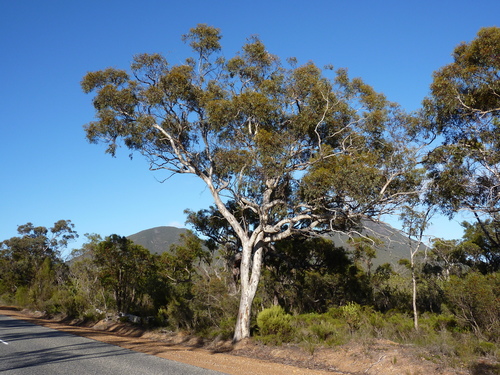
This tree, scientifically named Corymbia erythrophloia (Blakely) K.D.Hill & L.A.S.Johnson, typically grows to 15 metres (49 ft) in height. It has persistent tessellated bark on the trunk and lower branches, which can be red-brown, dull, grey or pink. The bark sheds in small polygonal flakes, giving the tree a mottled appearance. Young plants and coppice regrowth have petiolate leaves that are initially elliptical to egg-shaped, and later become lance-shaped. These leaves measure 55–125 mm (2.2–4.9 in) long and 20–55 mm (0.79–2.17 in) wide. Adult leaves are arranged alternately, are roughly the same dull grey-green shade on both sides, and are lance-shaped to broadly lance-shaped or curved. They are 90–236 mm (3.5–9.3 in) long and 20–35 mm (0.79–1.38 in) wide, tapering at the base to a narrowly flattened petiole 9–28 mm (0.35–1.10 in) long. Flower buds are arranged at the ends of branchlets on a branched peduncle 4–21 mm (0.16–0.83 in) long; each branch of the peduncle holds seven buds on thin pedicels 3–10 mm (0.12–0.39 in) long. Mature buds are oval or pear-shaped, 6–10 mm (0.24–0.39 in) long and 5–7 mm (0.20–0.28 in) wide, with a rounded, sometimes pointed operculum. Flowering occurs between January and April, and the flowers are creamy white. The fruit is a woody urn-shaped to roughly spherical capsule 11–21 mm (0.43–0.83 in) long and 10–16 mm (0.39–0.63 in) wide. The seeds are boat-shaped or oval, reddish brown, and have a wing on the end. Corymbia erythrophloia occurs along the east coast of Queensland, Australia, extending north to Queenstown on the Cape York Peninsula and west as far as the Gulf of Carpentaria. Its range reaches south to Hervey Bay, with an isolated population found further south to the west of Brisbane. It grows in grassy woodlands or on low rolling hills, in clayey or stony soils that are mostly of volcanic origin. It is often found growing alongside mountain coolibah or silver-leaved ironbark. In horticulture, this tree can be grown as a shade tree that attracts birds to gardens. It tolerates hot overhead sun and dry soils, and can grow in ordinary or enriched clay-containing soils with pH ranging from mildly acidic to mildly alkaline. It is pruned to retain a single main trunk, or sometimes left to develop multiple well-spaced trunks.