About Corymbia calophylla (Lindl.) K.D.Hill & L.A.S.Johnson
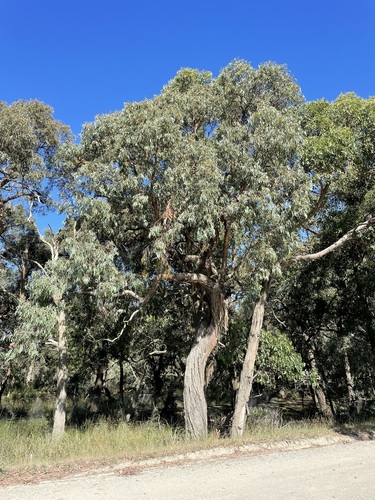
Corymbia calophylla (Lindl.) K.D.Hill & L.A.S.Johnson is usually a large tree, growing as a mallee when growing in poor soil. It typically reaches 40 metres (131 ft) tall, and can grow to over 60 metres (197 ft). The largest known recorded specimen is 71 m (233 ft) tall, with a 10.8 m (35 ft) girth and a wood volume of 134 m³ (4,700 cu ft). Its trunk can grow up to 2 m (6 ft 7 in) wide, and it develops large, thick, rambling branches. It has rough, tessellated grey-brown to red-brown bark that covers the entire trunk and all branches.
Adult leaves are arranged alternately, are thick and glossy green on both sides, and range from broadly lance-shaped to egg-shaped, with tapered or rounded leaf bases. The leaf blade is 9 to 14 centimetres (4 to 6 in) long and 25 to 40 mm (1.0 to 1.6 in) wide, attached to a narrowly flattened or channelled petiole 15 to 20 mm (0.6 to 0.8 in) long. It blooms between December and May, producing white to pink flowers. Flower buds are arranged at the ends of branchlets on a branched peduncle that is circular or angled in cross-section. Each branch of the peduncle holds groups of three or seven buds, attached to pedicels 6–37 mm (0.24–1.46 in) long. Mature buds are club-shaped or pear-shaped, 6–14 mm (0.24–0.55 in) long and 6–10 mm (0.24–0.39 in) wide, with a flattened operculum.
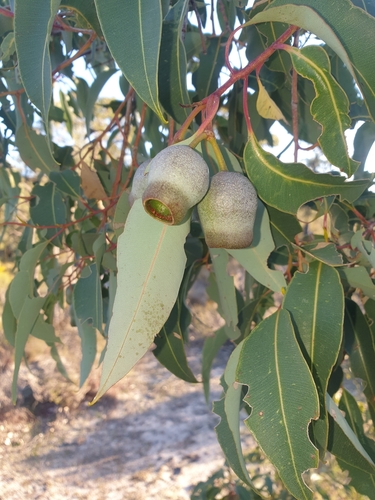
After flowering, it develops fruits called gumnuts that can stay on the tree for a year or more. The gumnuts are oval to urn-shaped, 30–50 mm (1.2–2.0 in) long and 25–40 mm (1.0–1.6 in) wide, attached to a pedicel 7–40 mm (0.3–1.6 in) long. The gumnuts hold large seeds that are an important food source for native birds such as cockatoos. This tree propagates easily from seed. It is distinct among bloodwoods for its very large buds and fruit, which are colloquially called honky (or honkey) nuts in Western Australia.
This species, commonly called marri, is widely distributed across the Southwest region of Western Australia, ranging from north of Geraldton (28° S) to Cape Riche (34° S), and extending inland beyond Narrogin (32°56′S 117° E). It demonstrates good adaptability to different environments on the Swan Coastal Plain and the Darling Scarp. Where soil conditions are suitable, it dominates the upper storey of woodland, growing to within a few kilometres of the coast. It can grow in relatively poor soil, but healthy large specimens are considered an indicator of good quality agricultural soils. It grows across a variety of terrains including flats, hills, breakaways, wetlands, fringing salt marshes and beside drainage lines, and can thrive in red-brown clay loams, orange-brown sandy clays, gravel and grey sandy soils overlying limestone, granite or laterite.
Marri is counted as one of the six forest giants native to Western Australia; the other five are Eucalyptus gomphocephala (tuart), E. diversicolor (karri), E. jacksonii (red tingle), E. marginata (jarrah) and E. patens (yarri). It is a common species, though its population has experienced large fluctuations due to land use change. When growing in favourable soils and climates, it is a dominant tree in multiple vegetation types, forming rich, close associations with many other species. Its fruits and seeds are eaten by various birds, and they are a staple food for the long-billed black cockatoo (Zanda baudinii) and red-capped parrot (Purpureicephalus spurius). Both species extract marri seeds from the woody gumnut by holding it with their foot and lower mandible, then inserting the tip of their upper mandible into openings in the seed-dispersing valve. The marks the lower mandible leaves on the marri nut can be used to distinguish between the parrot and cockatoo species.
In jarrah-marri woodland where marri shares the canopy with Eucalyptus marginata, common mid-story plant species associated with Corymbia calophylla include the tall shrub or tree Persoonia longifolia (snottygobble) and Kingia australis (bullanock). Mid-story species may also include Corymbia haematoxylon, which resembles a smaller version of C. calophylla. It can outcompete other eucalypts within its range; for example, in metropolitan Perth it displaces E. lane-poolei (salmon white gum) on all soils except the wetter Guildford soils. On the drier coastal plain of its northern range, only tuart (Eucalyptus gomphocephala) grows larger than marri.
Corymbia calophylla is named as one of the dominant taxa in the Corymbia calophylla–Xanthorrhoea preissii woodlands and shrublands of the Swan Coastal Plain, a critically endangered ecological community that was once widespread and now restricted to less than 3% of its original range. This is one of three documented marri-dominated plant assemblages, distinguished by the drier soils of the community's range along the eastern edge of the Swan Coastal Plain. After extensive conversion of land to agriculture in the 20th century, large old marri trees became rare, though in the 1870s, Mueller recorded specimens with trunks up to three metres wide. Removing marri trees from farmland has long been difficult, as they resist labour-intensive mechanical removal methods and ringbarking. A cost-effective removal method, demonstrated in 1904 at an experimental farm in Narrogin, was splintering trunks and roots with gelignite.
Marri trees hold an important place in Noongar culture, and the uses of their products were adapted and exported by the Noongar people of Southwest Australia. The kino called mayat that oozes from the tree contains tannins with antiseptic qualities. Noongar people powdered mayat and sprinkled it on open wounds to stop bleeding, added it to water to make a mouthwash or disinfectant, mixed it with clay and water to make a medicinal drink for dysentery, and used it to tan kangaroo skins for cloaks or bags. Colonist Jane Dodds of Guildford, Western Australia recorded that local people used it as a remedy for diarrhoea, noting "as we do rhubarb but it does not answer for Europeans". Rosendo Salvado, a Spanish Bishop, disputed this claim in his report on the remedy, which was used for a common ailment in the new colony when taken in tea or as one or two small lozenges; he stated it produces an effect within one day, but also warned that overdose can cause paralysis.
European migrants also adopted the use of marri kino for tanning animal skins. Early colonial literature often notes the blood-like appearance of the kino that flows from marri trees; George Fletcher Moore recorded its use in his diary in 1831. The colony began exporting marri kino to England. In 1879, Mueller stated that marri kino cost twenty to twenty five pounds per ton on London markets. A 1922 investigation by the state's forestry department recognised the value of the product. A method was patented to improve marri kino as a commercial tanning agent, by increasing its solubility and removing excess colour. Marri kino is composed of around two thirds tannins, and is unusual because it can be harvested without felling the host tree.
Traditionally, Noongar people used marri wood to make a variety of traditional tools including doarks (sticks for knocking the tops off grass trees), kitjs (spears) and wannas (digging sticks). Marri timber is increasingly used for modern household furniture. The timber is honey coloured and has a unique grain structure. However, it is not used for construction because its wood structure has complex faults. Trees that grow on alluvial soils contain less kino, producing timber that can be used for a wider range of applications. In 1897, state conservator of forest John Ednie Brown promoted the value of marri timber without gum veins, recommending it be used for fruit packaging; however, the 1922 commission found that while it is useful for that purpose and others, its irregular faults reduce its utility. This view was reaffirmed by the state conservator in 1957, though the report also noted the usefulness and high tannin content of marri kino.
In the 19th century, marri wood's strength saw it used for handles, spokes and other implements, and for some building construction applications, but it was found to deteriorate when used below ground. Although the timber is unsuitable for permanent construction, its availability in the mid-20th century led the Forestry Department to recommend it for lower cost housing and buildings, as scantling, in boat building, and in the construction of railway rolling stock. It failed testing for use as railway sleepers.
Marri blossoms can be used as a source of sugary syrup: the syrup can be sucked directly from the flower, or the blossom can be dipped into water to make a sweet drink. In 1843, colonial botanist James Drummond documented the preparation of this drink, called numbit. The blossoms also attract ngoowak (bees), and honey can be found in hollows in marri branches. Marri also attract birds that nest in its hollows, and the eggs from these nests can be eaten.
The tree's large, distinctive fruit appears in the work of author May Gibbs; her childhood in Western Australia arguably influenced her Gumnut babies series. Noongar poet Jack Davis celebrated the importance of marri in his poem 'The Red Gum and I'.
For horticultural use, this tree can be cultivated by sowing seeds directly at a planting site, or raised in pots to avoid damage to seedlings. It is commercially available as seed or established plants. Seed is harvested from the gumnuts between February and March, when seeds are mature inside unopened capsules. While it is not as commonly used for urban landscaping as the local peppermint tree, it has been selected for planting in public spaces and as a street tree in the suburbs of Southwest Australia. A tree grown at Kew Gardens from seeds collected in 1802 provided the specimens that Robert Brown used for his original description of the species. In Eucalyptographia (1879), Mueller noted that the tree could be grown in tropical climates, citing John Kirk's report of its successful introduction to Zanzibar, but added that its sensitivity to frost caused it to fail to establish in Melbourne, Australia and other cooler regions.