About Corymbia aparrerinja K.D.Hill & L.A.S.Johnson
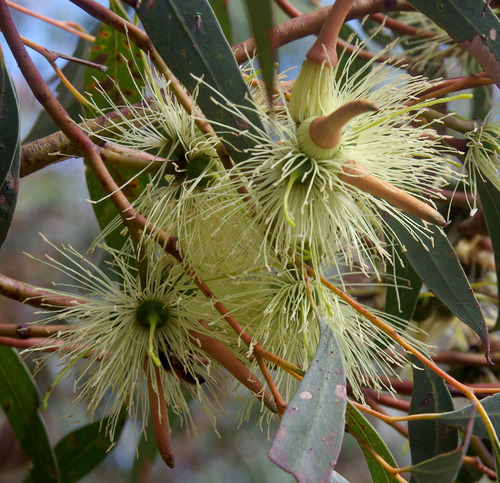
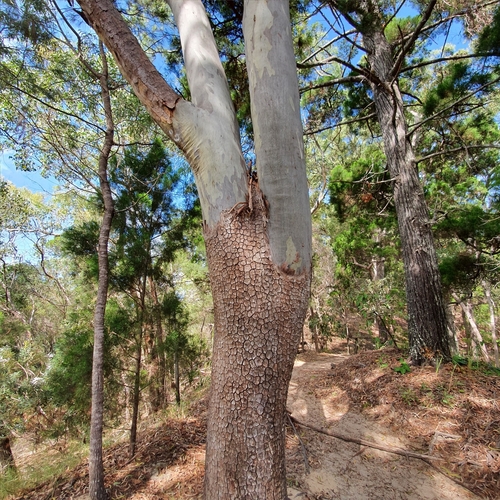
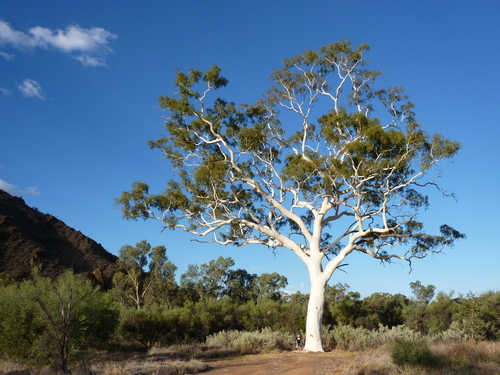
Corymbia aparrerinja is a tree that typically grows to a height of 20 m (66 ft), though it is often much shorter, and it forms a lignotuber. Its bark is smooth, sometimes powdery, and ranges in color from white to cream and pinkish, and is shed in thin patches. Young plants and coppice regrowth have egg-shaped leaves arranged in opposite pairs, measuring 50–155 mm (2.0–6.1 in) long and 20–65 mm (0.8–2.6 in) wide. Adult leaves are arranged alternately, are the same shade of glossy green on both sides, and are lance-shaped or curved. They measure 50–165 mm (2.0–6.5 in) long and 7–32 mm (0.3–1.3 in) wide, tapering to a petiole 5–20 mm (0.2–0.8 in) long. Flower buds are arranged at the ends of branchlets on a branched peduncle 5–38 mm (0.2–1.5 in) long. Each branch of the peduncle holds groups of three or seven buds, with individual buds attached to pedicels 2–5 mm (0.08–0.20 in) long. Mature buds are oval to pear-shaped, 6–7 mm (0.24–0.28 in) long and 5–6 mm (0.20–0.24 in) wide, with a rounded operculum. Flowering occurs in summer, and the flowers are white. The fruit is a woody cup-shaped to more or less cylindrical capsule 9–13 mm (0.35–0.51 in) long and 7–9 mm (0.28–0.35 in) wide, with valves that are near the rim level or enclosed. This species, commonly called ghost gum, grows in arid areas of Central Australia, found on rocky slopes, red sand flats, and dry creek beds. Its range extends from near Giles in Western Australia, through the southern part of the Northern Territory as far north as Tennant Creek, to areas near Mount Isa and Barcaldine in Queensland. Indigenous Australians used parts of this tree to treat colds.