About Corylus cornuta Marshall
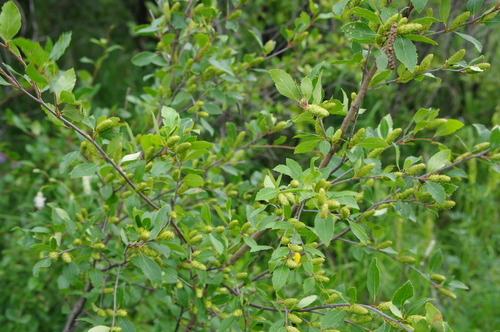
Corylus cornuta Marshall, commonly called beaked hazelnut, is a shrub that typically reaches 4–8 metres (13–26 feet) tall, with stems 10–25 centimetres (4–9+3⁄4 inches) thick and smooth gray bark. It can stay relatively small when growing in the shade of other plants, and usually grows with multiple trunks.
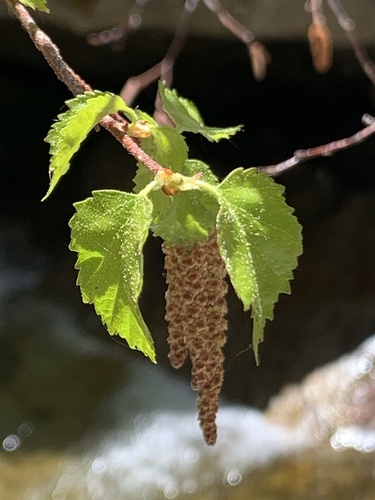
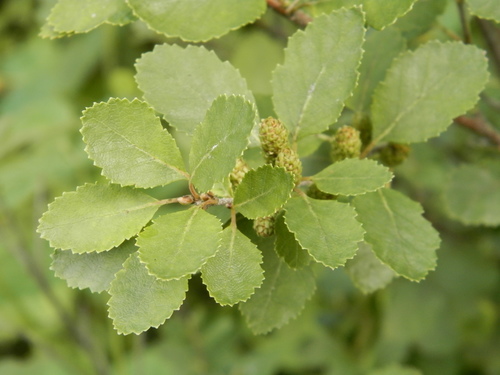
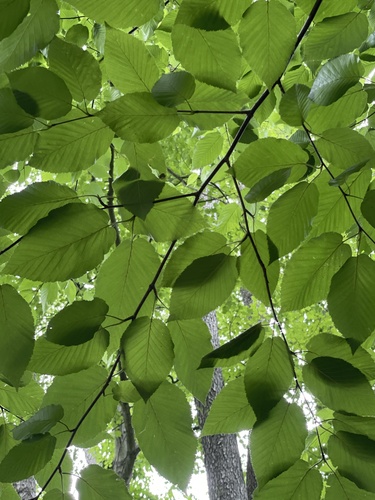
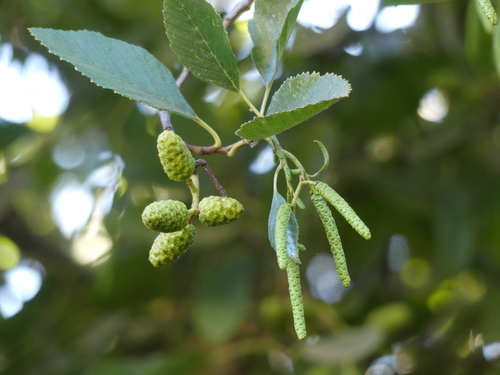
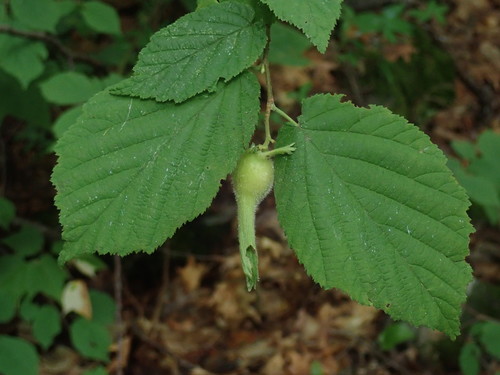
Its leaves are arranged in an alternate pattern, with a rounded oval shape, pointed tip, and irregularly double-toothed margins. They measure 5–11 cm (2–4+1⁄4 in) long and 3–8 cm (1+1⁄4–3+1⁄4 in) broad, with soft, hairy undersides. Male flowers are firm catkins that grow in clusters of 1 to 3 on the previous year's twigs, and become elongated and pendulous in spring. Single female flowers develop in early spring.
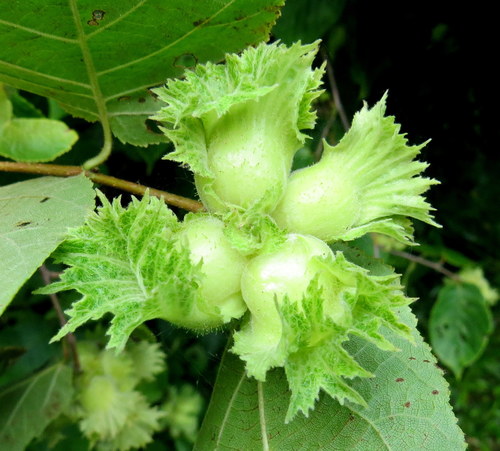
The species gets its common name from its fruit: a nut enclosed in a husk with a 2–4 cm (3⁄4–1+1⁄2 in) long tubular extension that resembles a beak. Tiny filaments stick out from the husk, which can penetrate and irritate skin on contact. The spherical nuts are small and surrounded by a hard shell. Beaked hazelnut is the hardiest of all hazel species, surviving temperatures as low as −50 °C (−58 °F) at its northern limits. It has a shallow, dense root system that is typically only 15 cm (6 in) deep, with a single taproot that can extend 0.6 m (2 ft) below the surface.
Two varieties have distinct ranges: eastern beaked hazel is found from southern Canada south to Georgia, while western beaked hazel occurs along the North American west coast from Alaska to California.
Although Corylus cornuta is somewhat shade tolerant, it is more common in forests with fairly open canopies than in denser forests. It cannot grow in fully open areas that are hot and dry. Fire kills the above-ground portion of the shrub, but it resprouts fairly readily after fire from its root crown or rhizomes. It recovers so well after fire that American Indians in California and Oregon used fire to encourage its growth. In boreal regions, it is threatened by the invasive Siberian peashrub, which can invade and become dominant in forest understories.
Deer, moose, and livestock browse the foliage of eastern beaked hazel, but western beaked hazel is considered to have low palatability for ungulates. The hazelnut weevil feeds exclusively on western beaked hazel. American beavers prefer browsing eastern beaked hazel, and consume it so frequently that they reduce its relative abundance in favor of conifers. The nuts of Corylus cornuta californica are an important food source for squirrels, especially as a backup when acorn crops fail. Douglas squirrels, red squirrels, and least chipmunks gather and store these nuts. While up to 66% of the stored nuts are consumed, the remaining nuts have a higher chance of germination because they are buried in soil or leaf litter. Squirrels only distribute the nuts up to around 90 m (300 ft) or less, but jays—blue jays in the east and Steller's jay in the west—distribute the nuts over longer distances. Black bears, turkeys, and white-tailed deer also eat the nuts. Ruffed grouse eat the protein-rich catkins and young buds of Corylus cornuta.
This plant provides cover for a variety of animal species, and good nesting habitat for birds, especially ruffed grouse. The white-footed vole is positively correlated with California hazelnuts in Oregon's Umpqua National Forest.
Beaked hazelnut has been cultivated by the Gitxsan, Tsimshian, and Nisga'a peoples for at least 7,000 years. Native Americans used its sprouts to make baskets, fish traps, and baby carriers. The nuts were eaten, and commonly used as a trade item among indigenous groups; both the Lewis and Clark expedition and early naturalist David Douglas bartered for beaked hazelnuts with local Indigenous peoples. The plant was used medicinally as an emetic, dewormer, astringent, and for teething. Its nut is considered excellent, and has the same uses as any commercial hazelnut. Beaked hazelnut produces fewer nuts than commercial European species such as common hazel or filbert, but it is more resistant to common diseases. It has been used in breeding programs to create high-yield, disease-resistant hybrid hazelnuts. It is also used in restoration plantings to increase biodiversity, improve food sources for wildlife, and reduce rates of laminated root rot in nearby Douglas-fir and Sitka spruce.