About Corylus avellana L.
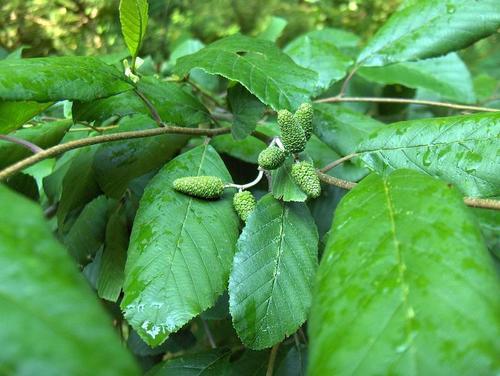
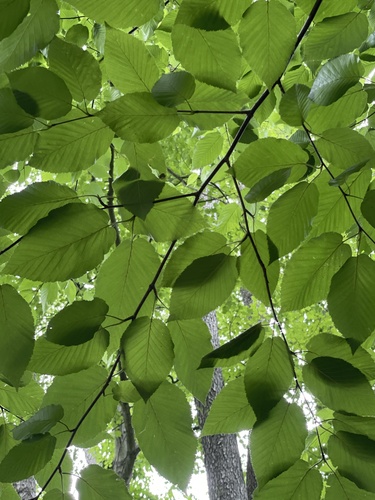
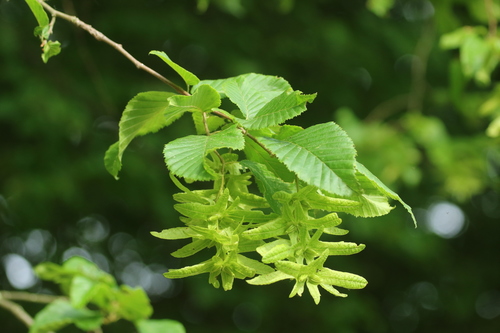
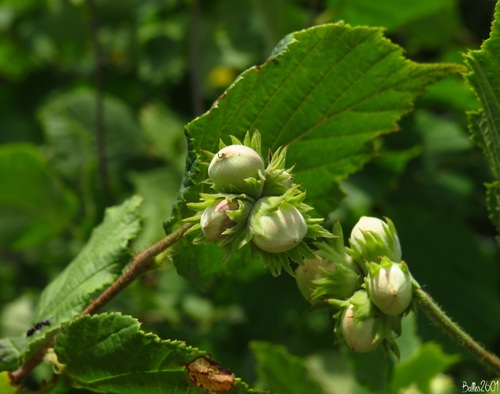
Common hazel (Corylus avellana L.) is typically a shrub that reaches 3–8 metres (10–26 feet) tall, and can occasionally grow as tall as 15 m (49 ft). Its leaves are deciduous, rounded, 6–12 centimetres (2+1⁄2–4+1⁄2 inches) long and wide, softly hairy on both surfaces, and have a double-serrate margin. Flowers emerge very early in spring, before new leaves develop, and the species is monoecious, producing single-sex wind-pollinated catkins. Male catkins are pale yellow and 5–12 cm long, while female flowers are very small, largely hidden within buds, with only bright red 1–3 millimetre (1⁄16–1⁄8 in) long styles visible. The fruit is a nut, produced in clusters of one to five. Each nut is held in a short leafy involucre, or husk, that encloses approximately three-quarters of the nut. The nut is roughly spherical to oval, 15–20 mm (5⁄8–3⁄4 in) long and 12–20 mm (1⁄2–3⁄4 in) broad, though some cultivated selections produce nuts up to 25 mm long. Nuts are yellow-brown with a pale scar at the base. When ripe, about 7–8 months after pollination, the nut falls out of the involucre. Common hazel can be easily distinguished from the closely related filbert (Corylus maxima) by its short involucre; in filberts, the nut is fully enclosed by a beak-like involucre that is longer than the nut itself. Corylus avellana is distributed from Ireland and the British Isles, south to Iberia, Italy, Greece, Turkey and Cyprus, north to central Scandinavia, and east to the central Ural Mountains, the Caucasus, and northwestern Iran. Common hazel leaves provide food for many animals, including Lepidoptera such as the case-bearer moth Coleophora anatipennella. Caterpillars of the concealer moth Alabonia geoffrella have been found feeding inside dead common hazel twigs. The fruit is an even more important food source for animals, including invertebrates adapted to bypass the nut shell, typically by laying eggs in female flowers that also provide protection for their offspring, and vertebrates that can crack open the nuts, such as squirrels and corvids. Both groups are considered pests by commercial hazelnut growers. The roots of C. avellana commonly act as a host for ectomycorrhizal fungi; in Great Britain, the most frequently recorded species are Laccaria laccata (the deceiver), Russula ochroleuca (the ochre brittlegill) and Paxillus involutus (the brown rollrim). In the Mediterranean region, the black truffle (Tuber melanosporum) grows on C. avellana roots. There are many named cultivars of common hazel; as of 2011, up to 400 C. avellana cultivars had been named. Named cultivars include Barcelona, Butler, Casina, Clark Cosford, Daviana, Delle Langhe, England, Ennis, Fillbert, Halls Giant, Jemtegaard, Kent Cob, Lewis, Tokolyi, Tonda Gentile, Tonda di Giffoni, Tonda Romana, Wanliss Pride, Willamette, and two Polish hazelnut cultivars: Kataloński and Webba Cenny. Some cultivars are grown for specific nut qualities such as large size, or early or late fruiting, while others are grown specifically as pollinators. The majority of commercial hazelnuts are propagated from root sprouts. Some cultivars are hybrids between common hazel and filbert. Two ornamental cultivars have earned the Royal Horticultural Society's Award of Garden Merit. The first is 'Contorta', commonly called corkscrew hazel or Harry Lauder's walking stick. Unlike other hazel varieties, this cultivar has curved and spiralling stems and puckered leaves, while its long elegant catkins are unchanged from the species. It was discovered in a hedge in 1863 in Gloucestershire on the Frocester Court Estate, and was popularised by owners of local estates such as Henry Reynolds-Moreton, 3rd Earl of Ducie, and horticulturalist Edward Augustus Bowles. It is now popular in gardens across the UK. The second is 'Red Majestic', a red-purple leaved cultivar bred from 'Contorta', so it also has a sprawling, contorted growth habit. According to the New Sunset Western Garden Book, the European hazelnut is among the most widely grown hazelnut plants for commercial nut production. This shrub is common in many European woodlands. It is an important component of the hedgerows that served as traditional field boundaries in lowland England. Historically, the wood was grown as coppice, with cut poles used for wattle-and-daub building and agricultural fencing.