About Corybas trilobus (Hook.f.) Rchb.f.
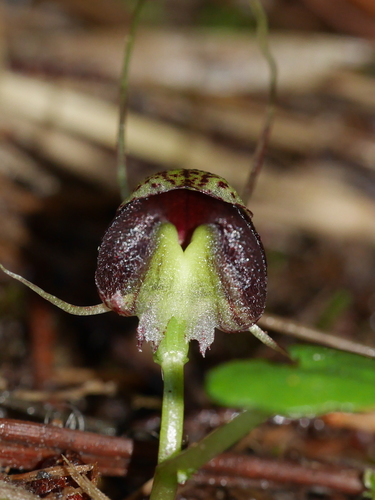
Corybas trilobus (Hook.f.) Rchb.f. is a variable terrestrial perennial herb, and the species boundaries of this taxon are still being actively clarified. The description below follows the 2016 sensu stricto delineation of the species. This species produces a single kidney-shaped (reniform) leaf that grows on a petiole 13–24 mm long. The leaf is at least 18 mm in diameter, longer than it is wide, with a broad apex that ends in a sudden sharp point, and a distinctly two-lobed base. A single flower is borne on a peduncle that bears a small, slender floral bract; the ovary is pale yellow-green and ribbed. The flower is characteristically mostly pale in color, with the only exception being the margins of its labellum. The dorsal sepal arches over the labellum, is broadly rounded at the apex, green in color, and does not extend past the labellum. It presses firmly against the apex of the labellum and does not fold backwards. The lateral sepals are long and thread-like (filiform), often crimson at the base that fades to crystalline pink or white near the tips. Petals are similar in shape to lateral sepals but noticeably shorter, though they still exceed 43 mm in length. The labellum is translucent green, but its borders are typically streaked or splotched with crimson-maroon. It is strongly downturned and rounded. Flowering occurs from September to November, and the peduncle elongates greatly as the seed capsule ripens. Corybas trilobus can be confused with several other species, including some within the C. trilobus species complex and some outside of it. Its distinguishing features include: a dorsal sepal that does not extend past the labellum or fold backwards, strongly reniform leaves, mostly pale elliptic flowers with slightly pigmented labella, and a long petiole and long petals. Like its close relatives, Corybas trilobus primarily inhabits the understories of southern beech forests made up of Nothofagus.