About Corybas iridescens Irwin & Molloy
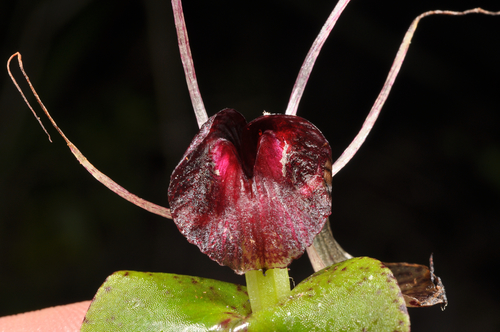
Corybas iridescens Irwin & Molloy is a terrestrial, perennial herb that produces a single, fleshy, oval-shaped leaf on a very short petiole. The leaf’s midrib is grooved, and its base may be slightly heart-shaped. The upper leaf surface is green, sometimes marked with maroon spots, while the lower leaf surface is silvery. Its ovary is curved, and it is accompanied by two slender floral bracts of unequal lengths. The shorter bract is reduced and points toward the leaf, while the longer bract is at least as long as the ovary and points away from the leaf. The dorsal sepal is long, extending well past the labellum, and is oval-shaped when flattened. Its apex often ends in a rather long, sharp tip that curves slightly upwards. This sepal may be silvery green with purple spots or stripes, or it may be entirely deep crimson. The lateral sepals are long and thread-like (filiform), pointing forwards, much longer than the labellum, and translucent white with purple flecking. The petals are similar in appearance to the lateral sepals, but are slightly shorter, and also have lobes at their base. The labellum is deep crimson (rare pale green individuals have been recorded), and it is iridescent when wet. Its lower portion may be translucent, but even when translucent it is still heavily flecked with crimson. Near its base, the labellum forms a tube-like structure that abruptly curves downwards, then flattens and expands to form the front-facing portion of the flower called the lamina. A bead-shaped callus sits on the labellum near its downward bend. The lamina is oval or circular, with its upper edges folded inwards, and ends in an abrupt sharp point. The inner parts of the labellum are covered in ridges and small backward-curving projections. The column is broad at the base and tilted backwards, and holds four pollinia arranged in two pairs. Flowering occurs from October to January. The peduncle lengthens greatly as the seed capsule ripens. This species is similar to Corybas macranthus, but can be told apart by several features: its leaves grow on short petioles and are often spotted; its dorsal sepal is broader (C. macranthus has a very slender dorsal sepal); its labellum has a prominent callus, and is almost always uniformly deep crimson or nearly black, and iridescent when wet. C. iridescens also flowers earlier than C. macranthus. Corybas iridescens is endemic to New Zealand’s North Island, South Island, and Chatham Islands. At the time this species was published, it was only known from western-central North Island localities, including Taranaki and Whanganui. It grows in coastal to montane habitats in calcium-rich substrates, such as those made of mudstone and siltstone (called papa rock locally), and limestone. It can also grow in basaltic substrates. It most often grows near seepages, or on the banks of slow-flowing streams.