About Corybas hypogaeus (Colenso) Lehnebach
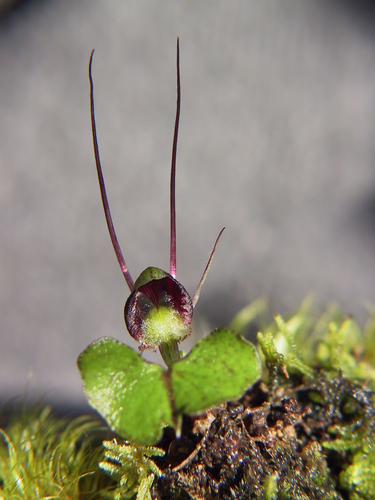
Corybas hypogaeus is a terrestrial, perennial herb that produces a single kidney-shaped to heart-shaped leaf on a 10–15 mm long petiole. The petiole is white or pale pink, with a sheathing bract at its base. The leaf is sometimes marked with maroon flecks; it is light green on the upper surface, and silvery or silvery purple on the lower surface. The tip of the leaf is divided into three lobes, with the central lobe ending in a sharp point, and the ear-shaped auricles at the leaf base are pronounced. This species produces one single flower borne on a short white to pale pink peduncle. Two floral bracts of unequal length accompany the flower: the smaller bract points toward the leaf, while the longer bract points away from it. The dorsal sepal is narrow at the base and widens toward its rounded tip; it is light green, often marked with purple flecks running down its center. It arches over the flower, and is equal in length to the labellum, or slightly longer. The lateral sepals are long, thread-like, and white to pink. The petals share this thread-like shape, but are shorter than the lateral sepals. The labellum is short, with an auriculate base. Its main body is strongly cupped, and its tip is distinctly deeply jagged (laciniate). It ranges from green to nearly white, and has maroon borders. Flowering occurs between August and September. As the seed capsule ripens, the peduncle becomes much longer. Corybas hypogaeus can be told apart from other members of the C. trilobus aggregate by its small, often leaf litter-buried flower, and its characteristic jagged, cupped labellum. It is very similar to the recently described species C. sanctigeorgianus, but differs by having a green-tinted rather than creamy white labellum center, and a dorsal sepal that is equal to or slightly longer than the labellum, rather than noticeably longer. In addition, C. sanctigeorgianus is only known from specific sites on New Zealand's North Island. This species is endemic to New Zealand's North Island and South Island. On the North Island, it has been recorded from the Hunua Ranges, Waikato, and Wairarapa. On the South Island, it is only known from north-west Nelson. It grows in lowland to montane habitats in kānuka or southern beech-dominated forest, and is typically found near the trunks of these trees or along the edges of swamps within the forest. It grows half-buried in deep drifts of decaying leaf litter, and usually only its leaf is exposed above ground.