About Corybas acuminatus M.A.Clem. & Hatch
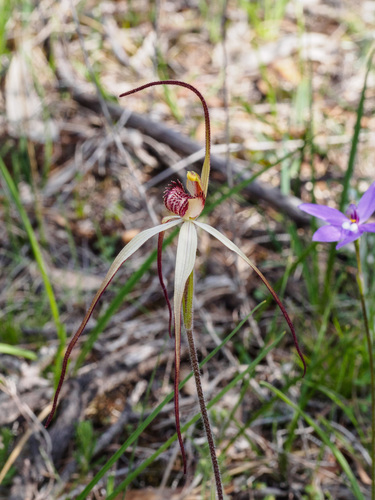
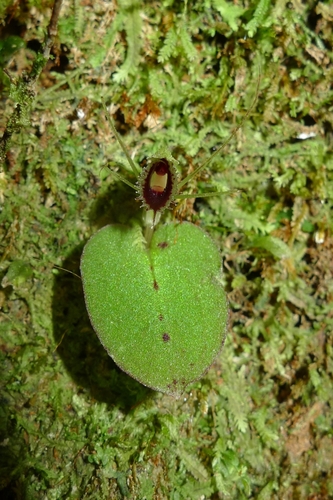
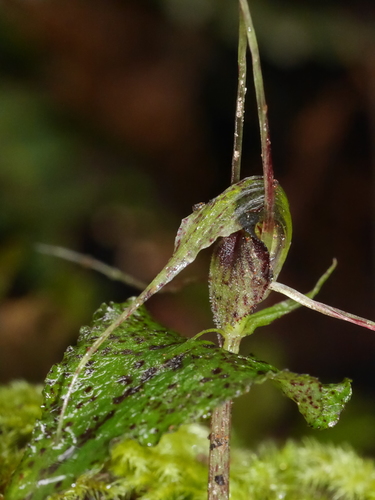
Corybas acuminatus is a terrestrial, perennial, deciduous herb that produces a single leaf. The leaf is triangular to heart-shaped with a sharply pointed tip, reaching up to 40 mm long and 20 mm wide. Its upper surface is light green, while the lower surface is silvery with red veins. A single more or less translucent flower marked with dull red striations grows directly above the leaf. The largest component of the flower is the dorsal sepal, which can be up to 40 mm long and ends in a long, horizontal, thread-like tip. The lateral sepals are erect, thread-like, and extend up to 60 mm past the rest of the flower. The petals are similar in shape to the lateral sepals but smaller, and are held either horizontally or pointing downwards. The labellum is a mix of red and creamy green, and has two rounded ear-shaped structures near its base. Flowering takes place from August to December. When not in flower, Corybas acuminatus can be mistaken for the leaves of Acianthus sinclairii, which also has a pointed heart-shaped leaf and maroon vein-like patterning. In Acianthus sinclairii, the veining appears embossed, while in Corybas acuminatus the veining lies within the leaf tissue. Additionally, leaves of Acianthus sinclairii are thicker and leathery, and do not have undulated edges, unlike the leaves of Corybas acuminatus. Corybas acuminatus may also occasionally be confused with pointed-leaved individuals of Corybas oblongus, as both species have maroon-patterned leaves, but they can be easily distinguished when in flower. This species, commonly called the dancing spider orchid, grows in moist, shady forests. It is found on the North, South, Stewart, Chatham and Auckland Islands.