About Corvus torquatus Lesson, 1831
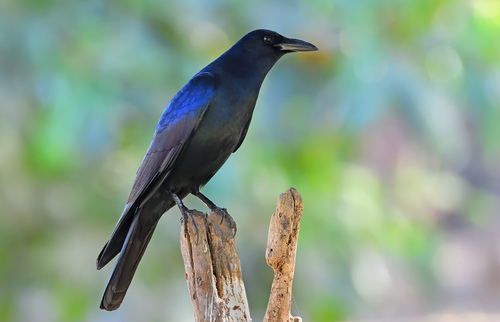
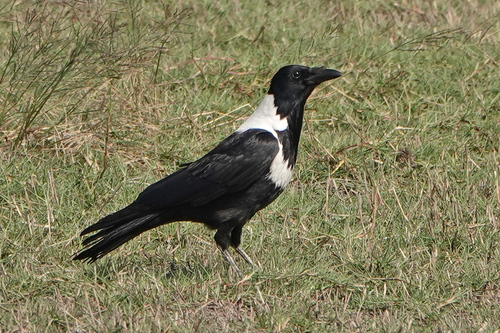
This species, the collared crow Corvus torquatus Lesson, 1831, measures 52–55 cm in total length. It is the same size as, or slightly larger than, the carrion crow Corvus corone, with proportionately slightly longer wings, tail, and bill. It is a sleek, handsome bird with glossy black plumage, with the exception of the back of the neck, upper back (mantle), and a broad band across the lower breast, which are white. Its bill, legs, and feet are all black. It sometimes flies with its feet hanging down below its body in a characteristic "lazy" posture. Its voice is a loud kaaar, repeated multiple times, with small variations to suit different contexts. Like many other corvids, it also produces unusual clipping and clicking sounds while performing a head-bowing display toward another individual. This species is found primarily across China, where it occupies a large area of the country, and does not range further north than Beijing. It lives in plains and low-lying river valleys in fairly open country and cultivated areas, and is commonly seen in paddy fields. It tends to avoid large towns and cities, and is predominantly a rural species. It searches for food mostly on the ground, and eats a wide variety of items: these include insects, mollusks and other invertebrates (which it even collects from shallow water), and grains, especially rice. It also searches through refuse left by humans to find suitable food. It appears to eat less carrion than other related crow species, but will feed on carrion when the opportunity arises, and will also consume eggs and nestlings. Its nest is usually built in a tree, and is plastered with mud. Clutches usually contain three or four eggs. In 2004, the International Union for the Conservation of Nature classified this species as Least Concern. It was upgraded to Near Threatened status in 2008, and has been classified as Vulnerable as of 2018.