About Corvus sinaloae L.I.Davis, 1958
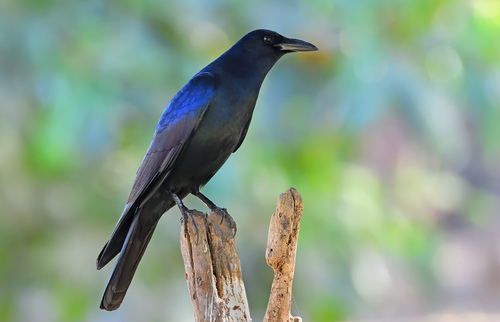
The Sinaloa crow (Corvus sinaloae) measures 35.5 to 38 cm (14 to 15 inches) in total length. Two recorded individuals weighed 229 g (8.1 oz) and 258 g (9.1 oz). Males and females share identical plumage, which is nearly indistinguishable from that of the Tamaulipas crow. Adult Sinaloa crows have glossy dark violet coloration on the crown, nape, secondary wing coverts, and secondaries. The sides of the neck, back, scapulars, rump, uppertail coverts, and primary coverts are glossy dark violet blue. Primaries and rectrices are dark steel blue, with a greenish tinge on the outer primaries and a violet tinge on the central rectrices. The sides of the head and the underparts are dark steel blue or greenish steel blue, growing more greenish toward the rear. Adult Sinaloa crows have a dark brown iris, a black bill, and black legs and feet. Juvenile Sinaloa crows are duller in overall plumage than adults. The Sinaloa crow is distributed across western Mexico, ranging from southern Sonora south to southwestern Nayarit, and east into western Durango. It inhabits gallery forest, deciduous forest, towns and villages, pastures, and agricultural land within the tropical zone. When the species was first described, L. I. Davis noted it also occurs "on wet sand of the sea beach when the tide is out and along river estuaries"; however, an earlier publication about the pre-split species C. imparatus stated that this group avoided "maritime associations". Sources also disagree on the species' elevation range: two sources list its range from sea level up to 1,000 m (3,300 ft), while one source states it only occurs as high as 700 m (2,300 ft).