About Corvus ruficollis Lesson, 1831
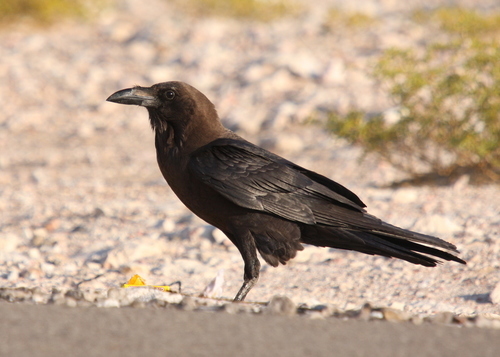
The brown-necked raven, with the scientific name Corvus ruficollis Lesson, 1831, is a larger bird than the carrion crow, measuring 52–56 cm in length, though it is not as large as the common raven. It shares similar proportions to the common raven, but its bill is not as large or deep, and its wings tend to be slightly more pointed in profile. The species gets its English common name from its distinct brownish-black head and throat. The rest of its plumage is black with a purple, blue, or purplish-blue gloss. Like the common raven, thick-billed raven, and white-necked raven, the brown-necked raven counts among the larger raven species. The feathers of this species often fade quite quickly to brownish black, even feathers that were originally truly black, and the bird can look distinctly brown by the time it molts. Its feet, legs, and bill are all black. The dwarf raven was formerly classified as a subspecies of this species, Corvus ruficollis edithae, but this taxon now appears to be more closely related to the pied crow (C. albus) than to the brown-necked raven. This species has a wide range across nearly the whole of North Africa, extending south as far as Kenya, across the Arabian Peninsula, and north into the Greater Middle East and southern Iran. It lives primarily in desert environments, and visits oases and palm groves. Its diet includes a wide variety of food items: carrion, snakes, locusts and other grasshoppers, stranded fish in coastal areas, grain stolen from bags, dates, and other fruits. When it is not persecuted, the brown-necked raven is quite fearless, but it quickly becomes wary and shy if it receives too much attention. A 2009 study conducted in Israel found that this species cooperatively hunts lizards, with some birds blocking exits while others hunt.