About Corvus ossifragus A.Wilson, 1812
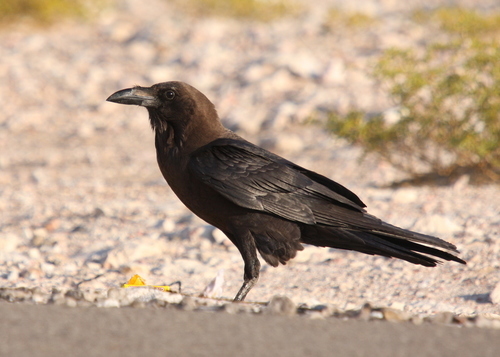
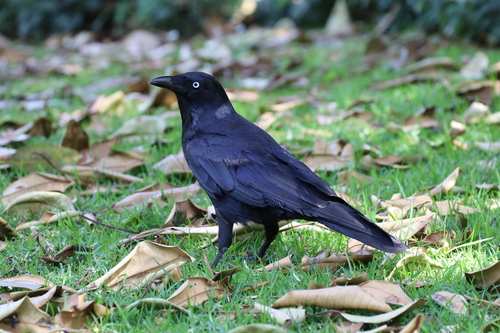
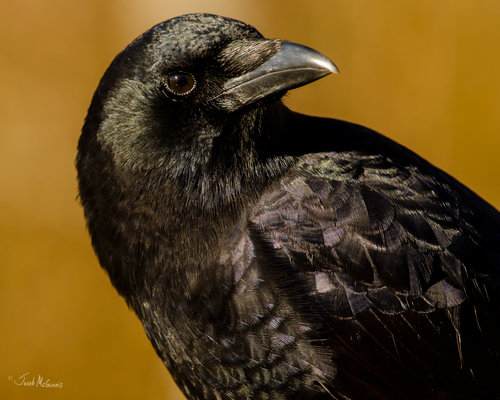
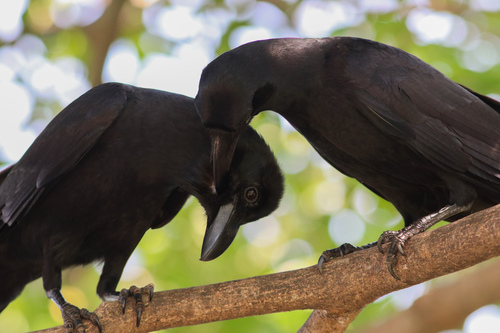
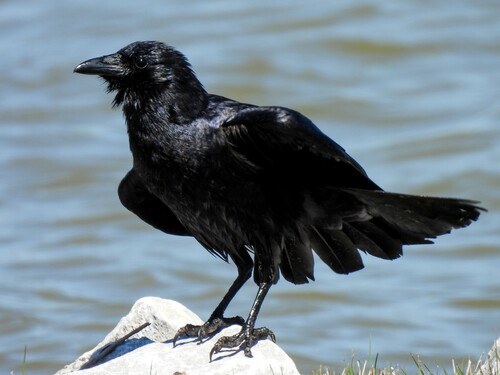
Corvus ossifragus, commonly known as the fish crow, is a medium-large bird. Average adult weights differ by sex: males weigh 280–320 grams (9.9–11.3 oz), and females weigh 247–293 grams (8.7–10.3 oz). This species has an approximate wingspan of 36 inches (90 cm), and a total body length between 36–40 centimetres (14–16 in). The fish crow is superficially similar to the American crow, but it is smaller, has silkier, smoother plumage, and usually has a somewhat slimmer bill. The fish crow's upperparts have a blue or blue-green sheen, while its black underparts carry a more greenish tint. Its eyes are dark brown. Differences between the fish crow and American crow are often only really obvious when the two species are seen side by side or when their calls are heard. Visual differentiation between the two species is extremely difficult and often inaccurate, even though consistent differences beyond size do exist. Fish crows typically have more slender bills and feet. A small sharp hook may also be present at the end of the fish crow's upper bill. When walking, fish crows also appear to have shorter legs. A more noticeable trait appears when calling: fish crows tend to hunch and fluff their throat feathers. Voice is the clearest outwardly differing characteristic between this species and the American crow. The fish crow's call has been described as a nasal "ark-ark-ark", a begging "waw-waw", or a single call that sounds like "cahrrr". In overlapping ranges, birders often use a common mnemonic to distinguish the two species: "Just ask him if he is an American crow. If he says 'no', he is a fish crow." This refers to the contrast between the American crow's distinct common "caw caw" call and the fish crow's nasal "nyuh unh" call. This species occurs along the eastern seaboard of the United States from Rhode Island south to Key West, and extends west along the northern coastline of the Gulf of Mexico. It frequents coastal marshes and beaches, rivers, inland lakes and marshes, river banks, and the land immediately surrounding all these areas. Fish crows are also found along many inland river systems for quite some distance, and have expanded their range along rivers since the early 1900s. Since 2012, fish crows have rapidly expanded into Canada, where breeding populations are now established along Lake Ontario, and into the Bahamas, where populations live on islands including Grand Bahama and Abaco.