About Corvus orru Bonaparte, 1850
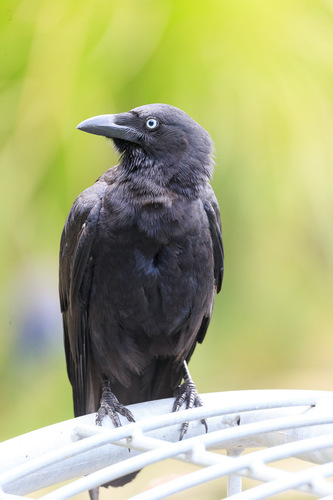
The Torresian crow (Corvus orru Bonaparte, 1850) is a large corvid, with a body length of 48 to 53 centimeters, which makes it around the same size as the Eurasian carrion crow. Compared to the Eurasian carrion crow, it has a more robust bill and slightly longer legs. Its plumage is glossy black on the back and dull black on the breast, with inconspicuous throat hackles. The species has a broad tail with a distinct square-shaped tip. Its dark grey bill is roughly the same length as its head, and its legs and feet are also dark grey, with pink foot soles. Like other Australasian Corvus species, the Torresian crow has a characteristic white iris and a fine blue eye-ring. It can be told apart from most other related species (except the little crow) by the white bases of its head and neck feathers; these white bases become visible when the feathers are ruffled. Birds of this species characteristically shuffle their wings after landing. Male and female Torresian crows look identical. Juveniles do not have glossy feathers on their back, and have blue eyes instead of white, until they reach around nine months of age. The Torresian crow should not be mistaken for the Australian raven, as juvenile Australian ravens have a similar appearance. Adult Australian ravens have distinctive long throat hackles, which may not be visible in some body postures. Even though the two species look similar, the Australian raven and the Torresian crow have distinct, unique calls. The Torresian crow has an extensive distribution across Australia, Papua New Guinea (especially the Bismarck Archipelago), and some islands in Indonesia, particularly the Moluccas. The range of the mainland Australian subspecies C. orru ceciliae stretches from tropical northern Australia south to Forster on the east coast of New South Wales, and to the area between Geraldton and Norseman in southwestern Australia. Within its geographic range, the Torresian crow lives in almost any habitat that has a permanent water source. It is common in tropical rainforests, eucalyptus woodland, open scrub, beaches, swamps, and offshore islands. The species is also well adapted to edge habitats, including farmland, towns, and cities. Across most of Northern Australia, it is the most numerous bird species on farms, and is considered a pest by farmers because it damages crops including sweetcorn, peanuts, wheat, and many types of fruit. Torresian crows are common in urban areas, and large populations live in many Australian cities and towns. In the arid zones of central Australia, the species is sparsely distributed and only found in areas with permanent water. Two additional subspecies are found on various northern islands: C. orru orru lives in Papua New Guinea and the Moluccas, and C. orru latirostris lives on Tanimbar and Babar Islands.