About Corvus mellori Mathews, 1912
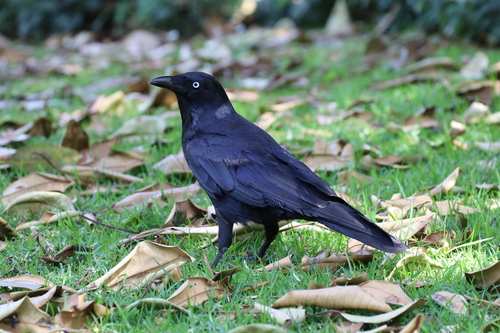
On average, the little raven (Corvus mellori) measures 48–50 cm in total length. It is somewhat smaller than the Australian raven, although their size ranges do overlap, and it also has a slightly smaller beak than the Australian raven. This species is more sociable than the Australian raven, and often forms large flocks that roam freely across wide areas to forage for food. Eye colour changes as the bird ages: nestlings up to three months old have blue-grey eyes; juveniles aged 3 to 11 months have brown eyes; immature birds up to one year and eleven months old have hazel eyes with blue eyerings around the pupil. Eyes turn white once the bird reaches full adulthood. The little raven is distributed across southeastern Australia, occurring across southern South Australia, Victoria, and New South Wales, and is also found on Kangaroo Island (South Australia) and King Island in the Bass Strait. It inhabits a variety of environments: scrub, agricultural areas, grazing pasture, woodlands, treeless plains, coasts, and suburbs. It is not present in western Gippsland, where forest ravens are the dominant corvid species. Due to its large geographic range, high abundance, and stable overall population, the little raven is classified as Least Concern on the IUCN Red List. Since the 1980s, the species has grown more abundant and widespread across Melbourne, expanding northwards and westwards while adapting well to urban habitats. In Melbourne, the Australian raven is only rarely recorded on the outer fringes of the city. The opposite pattern is seen in Canberra and Sydney: in these two cities, the Australian raven has successfully adapted to urban areas and become common, while the little raven remains uncommon.