About Corvus jamaicensis Gmelin, 1788
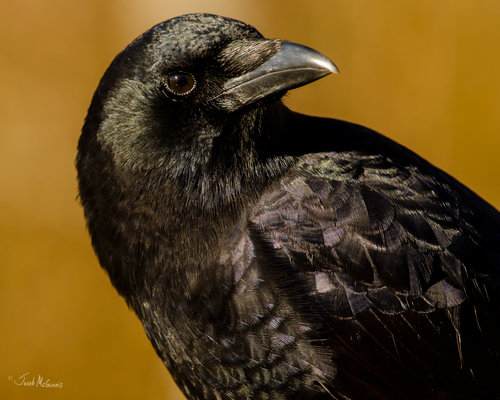
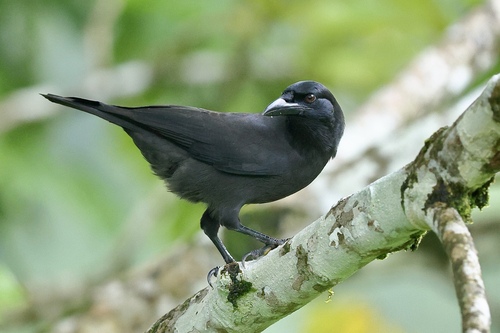
Corvus jamaicensis Gmelin, 1788 has an overall sooty-grey, non-glossy appearance, unlike its glossy relatives. It shares traits with its relatives, however: it has a similar dark grey patch of naked skin just behind the eye, and a smaller naked patch at the base of the bill. The bird’s bill is slate-grey, quite deep, and tapers to a sharp point. Its nasal bristles are relatively sparse, which usually leaves the nostrils visible. The iris is either grey-brown or red-brown, a difference that may depend on the individual’s age. The legs and feet are black. Like its two closest relatives, this species has a very distinctive voice. Its vocalizations include a range of jabbering and bubbling sounds, which gives it the common Jamaican Patois name jabbering crow. It also produces a slower, drawn-out "craaa-aa" and variations on that call, as well as somewhat musical burbling. As its scientific name suggests, this crow is found only on the island of Jamaica. It inhabits woodland mixed with cleared areas, and is frequently seen in larger gardens. Although it primarily lives in hill and mountain forest, it moves down to lower elevations during the dry season, when it is more likely to be observed. As a naturally forest-dwelling crow, a significant portion of its diet consists of fruit taken from trees. It forages either in pairs or small groups. It also probes under bark and leaf litter to find small invertebrates and lizards, and is known to raid other birds’ nests to take eggs and nestlings.