About Corvus frugilegus Linnaeus, 1758
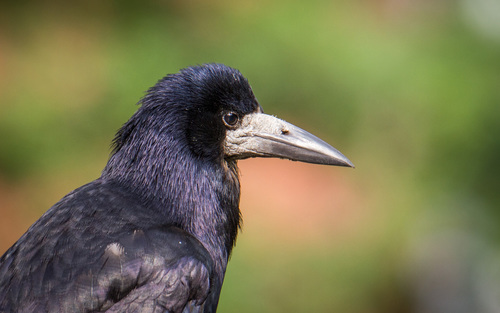
The rook (Corvus frugilegus Linnaeus, 1758) is a fairly large bird. Adult rooks weigh 280 to 340 g (9.9 to 12.0 oz), measure 44 to 46 cm (17 to 18 in) in length, and have a wingspan of 81 to 99 cm (32 to 39 in). Their feathers are black, and often show a blue or bluish-purple sheen in bright sunlight. The feathers on the head, neck and shoulders are particularly dense and silky. Their legs and feet are generally black, the bill is grey-black, and the iris is dark brown. Adult rooks have a distinctive bare area of whitish skin in front of the eye and around the base of the bill, which lets people distinguish rooks from other members of the crow family. This bare patch falsely makes the bill look longer than it actually is, and the head look more domed than it actually is. The feathering around the legs also looks shaggier and laxer than that of the similarly sized carrion crow, which is the only other member of its genus that rooks are commonly confused with. When seen in flight, rooks have proportionally longer and narrower wings than carrion crows. The average lifespan of a rook is six years. Juvenile rooks have black plumage with a slight greenish gloss. The hind neck, back and underparts are brownish-black, unlike the rest of the body. Juvenile rooks look superficially similar to young crows, because they do not have the bare patch at the base of the bill, but they have a thinner beak, and lose their facial feathers after about six months. Western rooks are resident in Ireland, Britain and much of north and central Europe, but are only vagrants in Iceland and parts of Scandinavia, where they typically live south of 60° latitude. Rooks live in habitats that common ravens avoid; they choose open agricultural areas with pasture or arable land, as long as there are suitable tall trees for breeding. They generally avoid forests, swamps, marshes, heaths and moorland. They are generally lowland birds, with most rookeries found below 120 m (400 ft). If suitable feeding habitat is available, they may breed at 300 m (1,000 ft) or even higher. Rooks are often associated with human settlements, nesting near farms, villages and open towns, but do not nest in large, heavily built-up areas. The eastern subspecies found in Asia is on average slightly smaller, and has a somewhat more fully feathered face. In the north of the species' range, rooks tend to move south during autumn, while more southern populations often range sporadically. The species was introduced into New Zealand, where several hundred birds were released from 1862 to 1874. Even though their range is very localized there, the species is now regarded as an invasive pest, and is actively controlled by many local councils. This control has wiped out the larger breeding colonies in New Zealand, and the remaining small groups have become more wary. Rooks are highly gregarious birds, and are generally seen in flocks of various sizes. Males and females form lifelong pair bonds, and pairs stay together within flocks. In the evening, rooks often congregate at their rookery before moving to their chosen communal roosting site. Flocks grow larger in autumn, as different groups merge and birds gather at dusk before roosting, often in very large numbers and alongside jackdaws. Roosting usually occurs in woodland or plantations, but a small minority of birds may stay roosting at their rookery through all winter, and adult males may roost collectively at a spot nearby. The birds leave promptly in the morning, dispersing distances of up to 10 km (6 mi). Large groups of rooks at breeding colonies or night roost sites can cause changes in soil properties. Soils at these sites have very high amounts of ornithogenic material. Foraging mostly happens on the ground. Rooks stride about, or occasionally hop, and probe the soil with their powerful beaks. Purposeful flight is direct, with regular wingbeats and very little gliding. When rooks are flying for leisure while wheeling near the rookery, they may glide far more extensively. In autumn, flocks sometimes perform spectacular aerial group flights, including synchronized movements and individual acrobatics such as dives, tumbles and rolls.