About Corvus crassirostris Rüppell, 1836
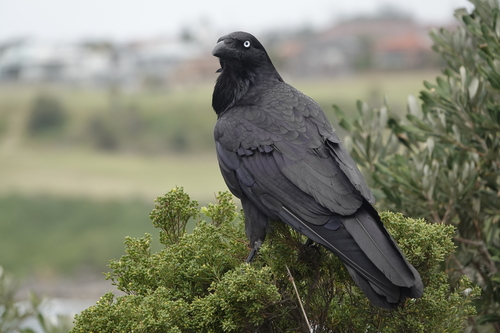
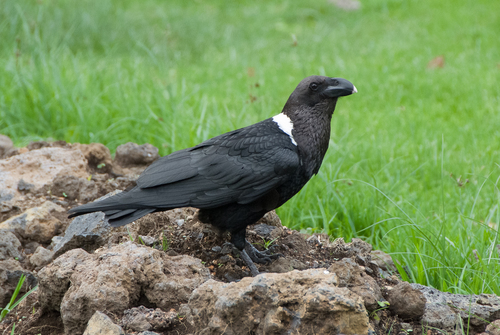
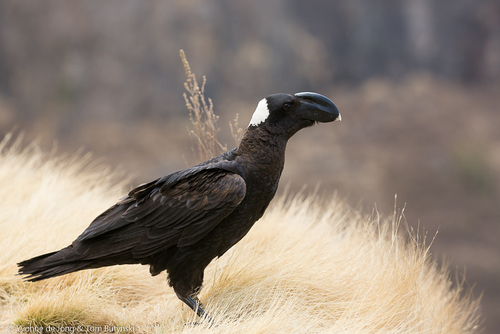
The thick-billed raven (Corvus crassirostris) is a corvid species native to the Horn of Africa. It shares the title of the largest bird in the corvid family with the common raven. On average, this species measures 64 cm (25 in) in length, with an overall length range of 60 to 70 cm (24 to 28 in). Females average approximately 1.15 kg (2.5 lb) in weight, while males average 1.5 kg (3.3 lb). Its average size is comparable to that of the largest common raven subspecies, which are found in the Himalayas, Greenland, and the Canadian Northwest Atlantic, though other common raven subspecies are noticeably smaller. Based on average body weights, the thick-billed raven is likely the heaviest living passerine. On average, it is around 25% heavier than the Australasian superb lyrebird, which is sometimes incorrectly named the largest passerine. It has a very large bill that is compressed laterally and has a deep curve along its profile, giving the species a highly distinctive appearance. This bill is the largest of any passerine, measuring 8–9 cm (3.1–3.5 in) in length. It is black with a white tip, has deep nasal grooves, and only has a light covering of nasal bristles. This raven has very short feathers on its head, throat, and neck. The throat and upper breast carry an oily brown gloss, and the rest of the bird’s plumage is glossy black. The only exception is a distinct white patch of feathers that runs from the nape onto the neck. The thick-billed raven’s distribution spans Eritrea, Somalia, and Ethiopia. It inhabits mountains and high plateaux at elevations ranging from 1,500 to 3,400 metres. It is one of multiple bird species endemic to northeastern tropical Africa.