About Corvus corone Linnaeus, 1758
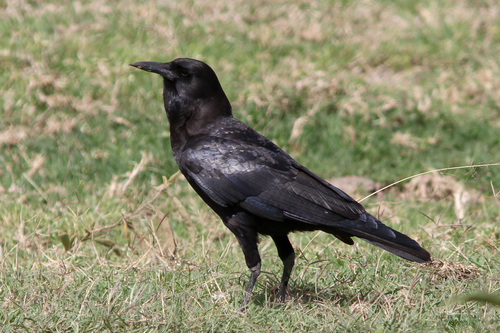
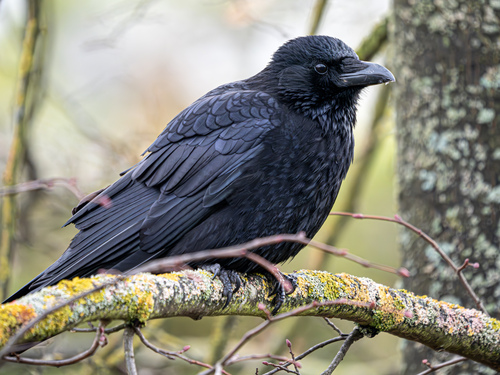
The carrion crow (Corvus corone Linnaeus, 1758) has all-black plumage with a green or purple sheen, which is noticeably greener than the gloss of the rook (Corvus frugilegus). Its bill, legs, and feet are also black. This species can be distinguished from the common raven by its smaller size: adult carrion crows measure around 48–52 cm (19–20 in) in length, while common ravens average 63 cm (25 in) long. It differs from the hooded crow by its fully black plumage. The carrion crow has a wingspan of 84–100 cm (33–39 in) and a body weight of 400–600 g (14–21 oz). Juvenile carrion crows can be identified by their brownish plumage and blue eyes; both traits darken to black and brown respectively as the bird matures. The carrion crow and the hooded crow (Corvus cornix) are very closely related species; the slightly larger allied subspecies C. c. orientalis belongs to the carrion crow. The geographic distribution of both forms of carrion crow across Europe is shown in the accompanying diagram. This current distribution may have formed from Pleistocene glaciation cycles, which split the original shared parent population into isolated groups. When the climate warmed, these isolated groups re-expanded their ranges and came into secondary contact. Poelstra and colleagues sequenced almost the entire genomes of both species across populations located at varying distances from this contact zone. They found that the two species are genetically identical both in their DNA sequence and in DNA expression as mRNA, with only one exception: a small portion (less than 0.28%) of the genome located on avian chromosome 18 has no expression in the hooded crow, and this lack of expression produces the lighter plumage coloration on the hooded crow’s torso. Because of this very limited genetic difference, the two species can produce viable hybrids, and they do occasionally hybridize in their contact zone. Even so, all-black carrion crows on one side of the contact zone almost exclusively mate with other all-black carrion crows, and hooded crows on the opposite side almost exclusively mate with other hooded crows. This means that only the difference in outward appearance between the two species acts as a barrier to widespread hybridization. The study authors attribute this pattern to assortative mating, rather than ecological selection. The adaptive advantage of this assortative mating is not currently understood, but the pattern could lead to the rapid emergence of new lineages and potentially new species through mutual attraction between individuals with similar new mutations. Unnikrishnan and Akhila have instead proposed that koinophilia is a more parsimonious explanation for the limited hybridization across the contact zone, even though there are no physiological, anatomical, or genetic barriers to hybridization between the two species. The carrion crow is also found in the mountains, forests, and cities of Japan. In terms of behaviour that helps distinguish it from rooks, rooks are generally gregarious while carrion crows are largely solitary. However, rooks will occasionally nest in isolated trees, and carrion crows may feed alongside rooks; additionally, carrion crows are often social when gathering at winter roosts. The most distinctive difference between the two species is their voice. The rook produces a high-pitched kaaa call, while the carrion crow’s call is a guttural, slightly vibrant, deeper croaked kraa that is distinct from any call made by the rook. The carrion crow is a noisy bird; it will perch on an elevated vantage point such as a building or the top of a tree and call three or four times in quick succession, with a slight pause between each series of croaks. During each series of calls, the crow may perform an accompanying gesture, raising its shoulders and bowing its head and neck downward with each caw. Its wingbeats are slower and more deliberate than those of the rook. Carrion crows can become tame in areas near humans, and they are commonly found near areas of human activity or habitation. They occupy a range of habitats including cities, moors, woodland, sea cliffs, and farmland, and they compete with other social birds such as gulls, other corvids, and ducks for food in parks and gardens. Like other corvid species, carrion crows actively harass predators and competitors that enter their territory or threaten them or their offspring, and they engage in group mobbing behaviour to defend themselves.