About Corvus albus Statius Muller, 1776
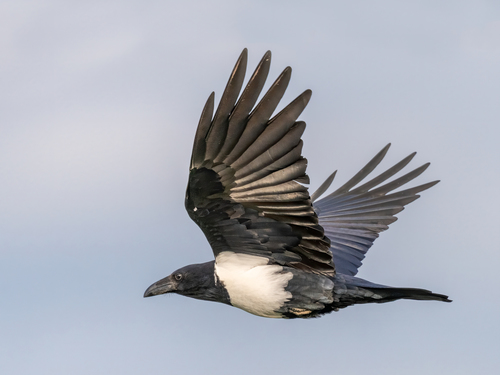
The pied crow (Corvus albus Statius Muller, 1776) measures 46–50 cm in length, around the size of the European carrion crow or slightly larger. It has a proportionally larger bill, slightly longer tail, wings, and legs than the European carrion crow. As its name suggests, its glossy black head and neck are interrupted by a large area of white feathering extending from the shoulders down to the lower breast. Its tail, bill, and wings are also black, and its eyes are dark brown. Immature birds often have white plumage mixed with black. It resembles both the white-necked raven and the thick-billed raven, but has a much smaller bill than these species. In southern Africa, the pied crow's range overlaps with that of the white-necked raven. Compared to the larger white-necked raven, which has a black chest and belly and a weightier, white-tipped beak, the pied crow is slightly smaller, has a white chest and belly, and a more delicate black beak. The pied crow is larger than the black crow. This species is the most widespread member of the genus Corvus in Africa. It occurs across sub-Saharan Africa, specifically in Nigeria, Ghana, Senegal, Sudan, Somalia, Eritrea, Zambia, Botswana, Mozambique, Zimbabwe, and South Africa, as well as on the large island of Madagascar, the Comoros Islands, Aldabra, Assumption Island, Cosmoledo, Astove Island, Zanzibar, Pemba, and Fernando Po. It mainly inhabits open country near villages and towns, and does not live in the equatorial rainforest region. It is rarely seen very far from human habitation, though it is not as closely tied to urban life as the Asian house crow (Corvus splendens), and can be found far from human habitation in Eritrea. Nests are usually built in tall, isolated trees, though smaller trees are sometimes used depending on availability. The cross supports of telephone poles are also frequently used as nesting sites, and both sexes build the nest. A clutch of three to six pale green eggs spotted with various shades of brown is laid between September and November, with timing depending on latitude. When the incubating female leaves the nest, she normally covers the eggs. Incubation lasts 18–19 days, and young usually fledge at around 45 days old. Both sexes help rear the young.