About Cortinarius violaceus (L.) Gray
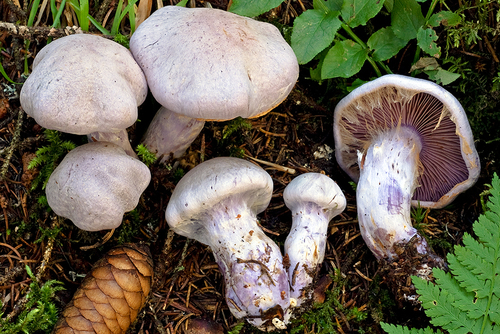
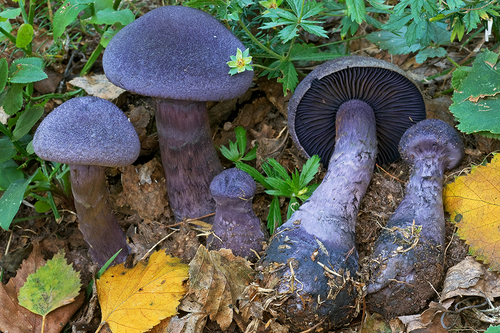
Cortinarius violaceus (L.) Gray has a cap that starts convex and matures to broadly convex, umbonate, or flat, measuring 3.5–15 centimetres (1+3⁄8–6 in) in diameter with an incurved margin. The cap is dark violet to blue-black, covered in fine, downy scales. Its cap tissue layer (pileipellis) is most often a trichoderm — a layer of parallel hyphae running perpendicular to the cap surface, 6–22 μm wide — and rarely an ixocutis, a layer of gelatinized hyphae 2–11 μm wide. Unlike many other Cortinarius species, the cap surface is neither sticky nor slimy, though it may occasionally be greasy. The stipe (stalk) is 6 to 18 cm (2+1⁄3 to 7 in) tall and 1 to 2 cm (3⁄8 to 3⁄4 in) thick; its swollen, bulbous base can sometimes reach up to 4 cm (1+1⁄2 in) wide. The stipe matches the cap's color closely and is covered in wool-like fibrils, and purple mycelium may be present at the base. Young specimens have a veil that quickly disappears as the mushroom matures. The mushroom's flesh is violet, darker beneath the pileipellis and inside the stipe. It has a mild taste faintly reminiscent of cedar wood, with a slight, pleasant scent also similar to cedar wood. The gills are dark violet, fading to purplish-brown as the mushroom ages, and connect to the stipe via an adnate attachment; they can become very dark in older specimens. The mushroom stains red when exposed to potassium hydroxide (KOH). Fruit bodies of the subspecies C. v. hercynicus are less robust than those of the nominate subspecies. Cortinarius violaceus produces a rust-coloured spore print. Individual spores measure 12 to 15 μm by 7 to 8.5 μm, have a rough texture, range from elliptical to almond-shaped, and are covered in medium-sized warts; spores are wider in C. v. hercynicus. This species is the only member of the genus Cortinarius that has cystidia on both the faces and edges of the gills. Cystidia are abundant, measuring 60 to 100 μm by 12 to 25 μm each; they are flask-shaped and contain somewhat purple contents. Cortinarius violaceus is distributed across North America, Europe, and Asia. While it is widespread, it is not common anywhere in Europe, and it is listed as endangered in the British Isles. It is a rare component of subarctic areas of western Greenland, and has not been recorded in Iceland. In Europe, it produces fruit bodies in deciduous woodland during autumn, growing especially among oak, birch, and beech, though it also occurs occasionally with conifers. It is occasionally found on treeless heathland, where it associates with bracken, and it prefers acidic soil. Cortinarius violaceus forms mycorrhizal symbiotic associations with several tree species, in which the fungus gains carbon from the plant and provides the plant with beneficial minerals. In Nordic countries, known host trees include white birch (Betula pubescens), silver birch (B. pendula), European aspen (Populus tremula), and rarely European beech (Fagus sylvatica); there are no records of association with oak (Quercus) in this region. Brandrud reported that the subspecies he described as C. violaceus hercynicus grows with Picea abies, generally in more alkaline soils alongside mosses from the genera Hylocomium and Pleurozium; in moister areas, it also grows with big shaggy-moss (Rhytidiadelphus triquetrus) and the buttercup-family shrub Hepatica nobilis. In Greenland, the species grows with Betula pubescens, and it associates with hazelnut (Corylus avellana) in Central and Southern Europe. In North America, C. violaceus prefers conifers; while rare across most of the continent, it is relatively common in certain areas including Mount Rainier National Park and Olympic National Park. It is more common in old growth forest in the Pacific Northwest, though it has also been found in regrowth areas populated with fir, pine, aspen, and alder in the Great Lakes region. Fruit bodies grow singly or in small groups, often near rotting wood, and can form fairy rings. Closely related species that resemble C. violaceus are found in Central and South America, Australia, New Zealand, Papua New Guinea, and Malaysia.