About Cortinarius varius (Schaeff.) Fr.
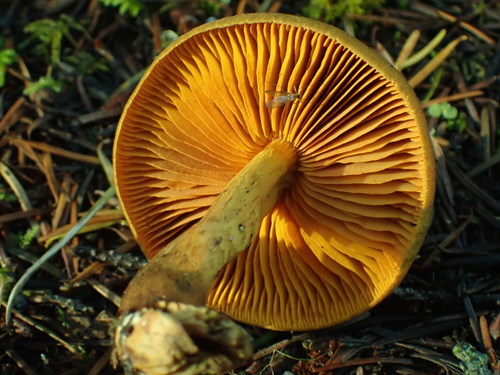
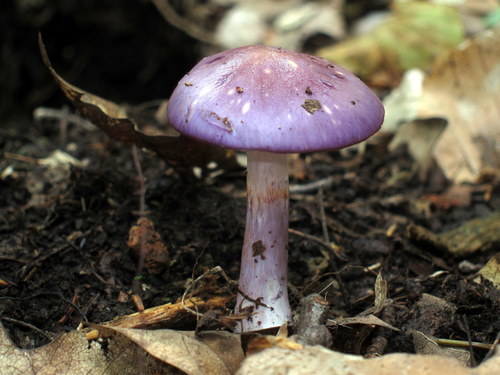
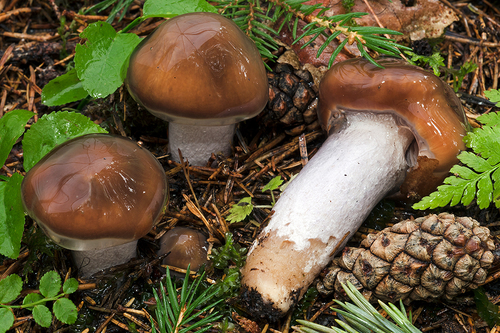
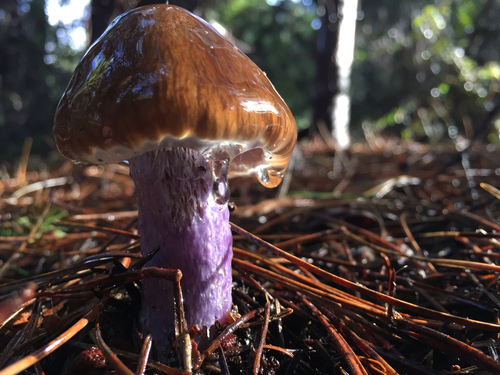
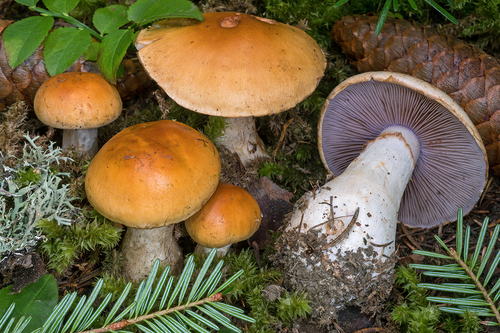
Cortinarius varius (Schaeff.) Fr. The cap of this mushroom is 5–10 cm (2.0–3.9 in) in diameter. It starts spherical to convex, then becomes flattened or depressed. When young, it has a thin involute margin that carries fragments of the veil. The cap surface is sticky and smooth, with an orangish-yellow color that has a light ochre tint; it is yellower at the edge than at the center, which has more of a rusty yellow tone. The gills are densely crowded, usually somewhat emarginate (notched), thin, and not very broad, measuring 5–8 mm across. They start a rich cornflower blue, turn lilac, and finally become ochre-cinnamon, with a slightly scalloped edge. The stem is solid, thicker at the lower end in a club shape. It is typically quite short when young, then often elongates; it grows 5–10 cm (2.0–3.9 in) high and 0.6–1.5 cm (0.2–0.6 in) wide, with the swollen lower part reaching up to 2 cm (0.8 in) or more. Depending on the mushroom’s maturity, the stem surface ranges from covered in pressed fine hair tufts, to fibrillose, to nearly smooth. The stem is white, with a faint blue to lilac tinge at the top that fades with age; it is slightly yellowish-cream below, and turns fully pale yellowish-ochre when old. The cortina, a cobweb-like partial veil made of silky fibrils, is white when young, and later becomes cinnamon as the mushroom releases its spores. The flesh is firm, finely and compactly fleshy. It is white in the cap, and develops a faint yellow tinge over time; in the stem it is undulatingly fibrillose, and also carries a faint yellowish tinge. The mushroom has a pleasant odor, and a pleasant, mild taste. Different sources report it as either inedible or edible, and it has been used for pickling. Its spores are light rusty-brown, ellipsoid to almond-shaped, and measure 10–15 by 6.5–7.5 μm, with a distinct oblique apiculus. When tested chemically with a dilute solution of potassium hydroxide or ammonia, the flesh turns a chrome yellow color. Cortinarius varius is closely related to Cortinarius variosimilis, a North American species that has a paler cap, paler gills, and shorter spores. Fruit bodies of Cortinarius varius grow in groups in coniferous forests, and can also be found in glades and at wood edges. They fruit from the end of summer until late autumn, when frosts begin. It is common in some locations and quite rare in others, and it prefers calcareous soils.