About Cortinarius vanduzerensis A.H.Sm. & Trappe
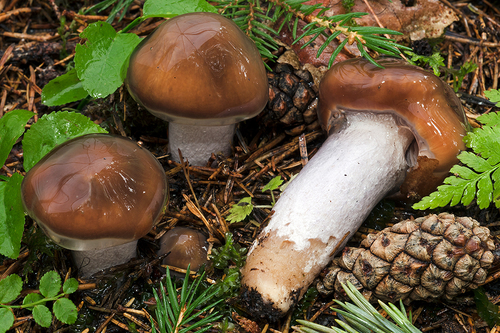
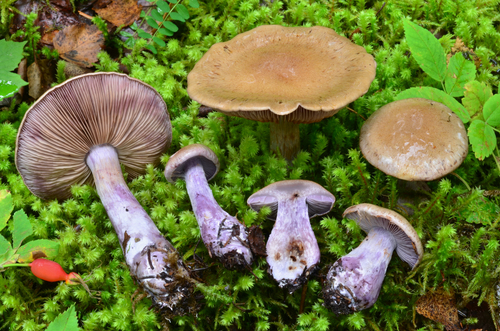
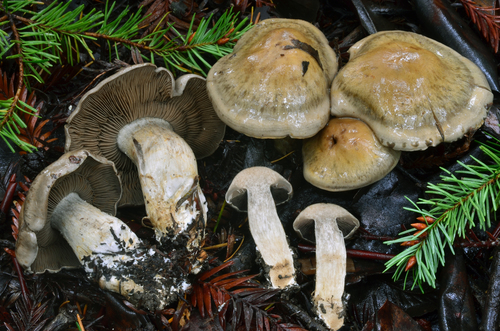
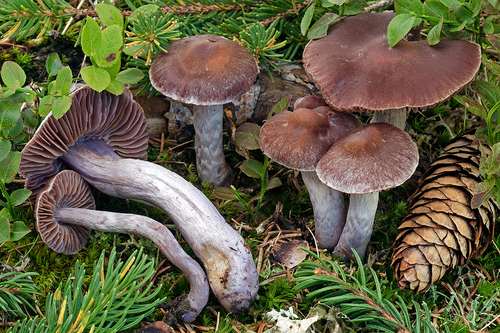
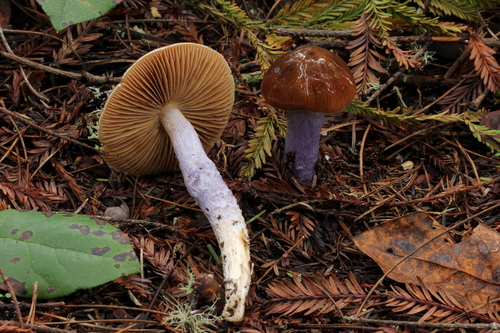
Young fruit bodies of Cortinarius vanduzerensis are covered by a slimy universal veil; the slime layer persists on the cap of young mushrooms, and also remains in moist weather. Young caps are oval to conical, with the margin initially pressed against the stem; as they mature, caps expand to become broadly conical or somewhat flattened, reaching a final diameter of 3.5–9 cm (1+1⁄2–3+1⁄2 inches). Cap color starts as chestnut-brown to black and lightens to paler brown as the mushroom matures. The cap surface is radially wrinkled or corrugated, especially near the margin. The mushroom's flesh is pallid when cut, and quickly becomes pale cinnamon-buff. Its odor and taste are not distinctive. A drop of FeSO4 solution, a common mushroom identification reagent, applied to the cap surface turns olive-green. Young gills (from unopened caps) are pinkish-buff, becoming dull cinnamon-brown at maturity when spores develop. Gills are closely spaced, and attach to the stem either adnate (levelly attached) or adnexed (slightly notched at attachment). The stem measures 7–20 cm (3–8 inches) long, 1–2 cm (3⁄8–3⁄4 inches) thick, and tapers slightly toward its base. The interior of the stem is pallid, and slowly turns cinnamon-buff at least near the base. The stem surface is covered by a thick slime veil: the upper portion of the stem is lavender to light purple, while the lower portion is darker. The universal veil sometimes breaks into concentric zones across the lower third of the stem. The edibility of this mushroom is unknown. David Arora notes that it is "much too slippery to be of value", and it is not recommended for eating because it resembles deadly poisonous species. The spore print of Cortinarius vanduzerensis is rusty-brown. Spores are broadly elliptic to ovate (egg-shaped) when viewed face-on, and broadly inequilateral when viewed in profile; they measure 12–14 by 7–8 μm. The spore surface is roughened with warts, and spores do not have an apical pore. Each spore contains two nuclei. The spore-bearing basidia in the hymenium are four-spored, broadly club-shaped, and often contain yellow masses or granules when stained in Melzer's reagent. Cheilocystidia (cystidia on the gill edge) are club-shaped, sometimes with an abruptly tapering point, and measure 17–26 by 9–15 μm. Pleurocystidia (cystidia on the gill face) are absent. Gill tissue is made of hyphae arranged in a roughly subparallel (almost parallel) pattern, and also contains brownish to orange-brown fat-containing hyphae. The cap's outer tissue layer (epicutis) is made of a turf of gelatinous hyphae 2.5–6 μm wide; clamp connections are absent to rare in these hyphae. Veil hyphae are 4–8 μm wide, and are hyaline (translucent) to yellow when mounted in dilute KOH solution. Hyphae in the stem cortex are arranged subparallel, and clamp connections are present here. Cortinarius vanduzerensis is a mycorrhizal mushroom that forms associations with conifer trees. Its fruit bodies grow singly, scattered, in rings, or in groups under spruce, hemlock, and Douglas-fir. This species is only known from the Pacific Northwest region of North America, including the Queen Charlotte Islands on the north coast of British Columbia, Canada. It fruits in autumn and early winter, or in late summer in western Canada. Reports of its abundance vary: it has been described as "very common", "fairly common", or "rare" everywhere except Oregon.