About Cortinarius rubellus Cooke
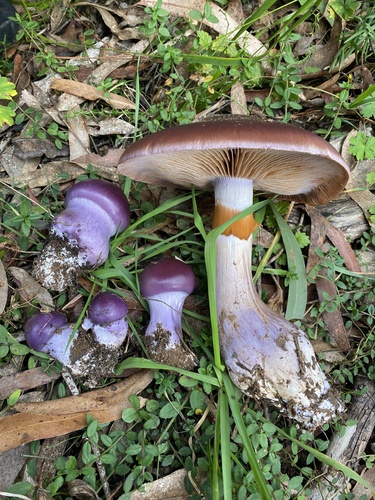
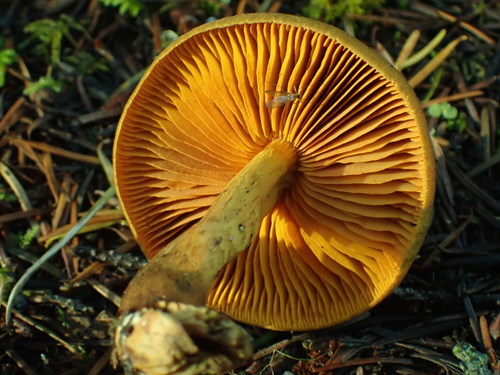
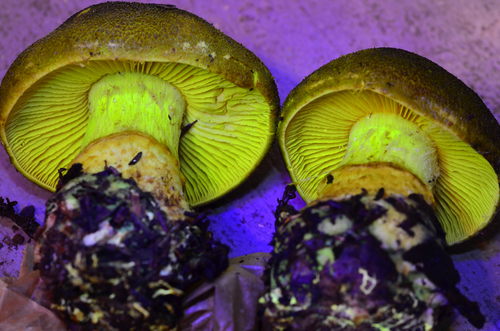
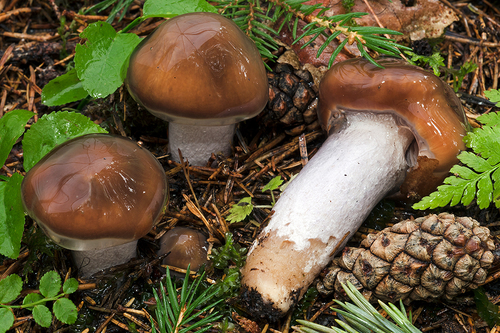
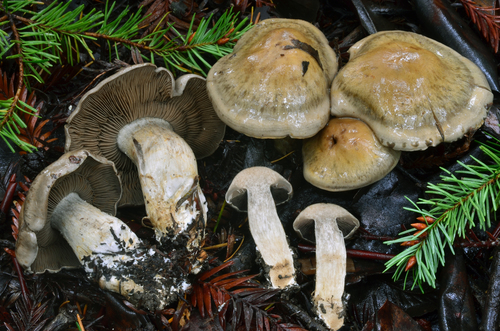
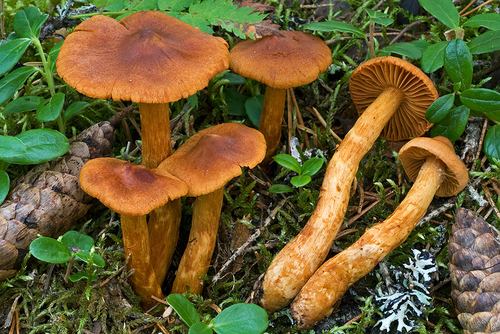
Cortinarius rubellus, scientifically named Cortinarius rubellus Cooke, has a cap that ranges from conical to convex, becoming partially flattened and umbonate when mature. Its diameter measures 2.5 to 8 centimetres (1 to 3+1⁄4 inches). The cap is tawny to date brown with paler margins, and covered in fine fibrous scales. The gills are originally ochre or caramel-colored, and darken to a deeper brown with age as spores mature. Gills attach to the stipe in an adnate arrangement. The stipe is 5.5 to 11 centimetres (2+1⁄4 to 4+1⁄4 inches) tall and 0.5 to 1.5 centimetres (1⁄4 to 5⁄8 inches) thick, with a bulbous base. It matches the cap color or is slightly paler, and may have yellow fragments of the partial veil called a cortina attached to its lower half. The flesh is cream or pale yellow, turning more tan below the cap cuticle (pileipellis) and at the base of the stem. It has a faint radish-like odor and no strong distinct taste. This species has been recorded in high-latitude temperate to subalpine forests across the northern hemisphere. Documented locations include subalpine conifer forest in the Yatsugatake Mountains of Yamanashi Prefecture, central Japan; in North America it occurs in British Columbia and western Washington, particularly Mount Rainier National Park. It is also found in Scandinavia and northern parts of the British Isles. Cortinarius rubellus generally grows in wet areas of conifer woodland, or mixed conifer and broadleaf woodland, and is an uncommon species. Cortinarius rubellus contains orellanine, a potent mycotoxin. Poisoning risk from this species was first recognized in 1972 in Finland, where four poisoning cases occurred, two resulting in permanent kidney failure. In 1979, three holidaymakers near Inverness were poisoned after mistaking this mushroom for chanterelles; two of the three needed kidney transplants. Between 1979 and 1993, 22 people were poisoned in Sweden, nine of whom required kidney transplants after developing end stage kidney failure (ESRF). Misidentification involved mistaking this toxic mushroom for edible species including chanterelles, Craterellus tubaeformis, and Hygrophorus species. Edible Craterellus tubaeformis can be told apart by its funnel-shaped cap and ridges rather than true gills on its underside. In 1996, one person in Austria ate this species while foraging for magic mushrooms. In September 2008, author Nicholas Evans (writer of The Horse Whisperer), his wife Charlotte Gordon Cumming, and two other relatives were accidentally poisoned after collecting and eating this deadly webcap on holiday. Evans had misidentified the mushrooms as ceps, and missed that the specimens had gills rather than the pores characteristic of ceps. All four victims were told they would need kidney transplants in the future. Several years after the poisoning, Evans received a donated kidney from his daughter Lauren. The other three recipients eventually got transplants after a period of searching for donors, even though Charlotte Gordon Cumming had only eaten three mouthfuls of mushroom. This group went on to help found the charity Give a Kidney.