About Cortinarius praestans (Cordier) Gillet
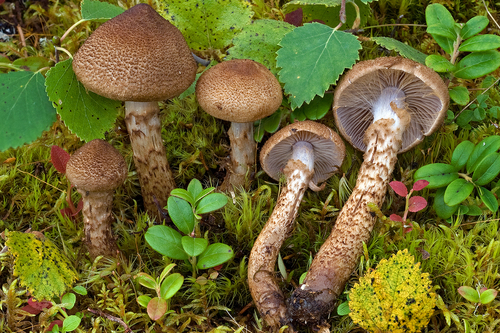
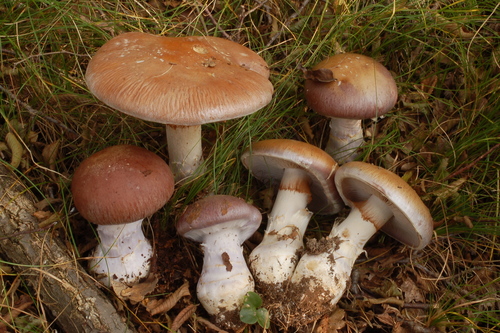
Mature fruit bodies of Cortinarius praestans have convex caps that typically reach 10–20 cm (3.9–7.9 in) in diameter, and usually have grooved rolled-in margins. The cap surface is chestnut or chocolate-brown with a violet-copper tint, and bears a light covering of fibrils and veil remnants that may look pressed against the surface or appear as small scales. The gills are whitish with an amethyst tint when young, and mature to creamy clay or rust color. They are closely crowded, with usually wavy, scalloped edges. The solid stem is 10–15 cm (3.9–5.9 in) long and 3–5 cm (1.2–2.0 in) thick, with a thickened, emarginate, roughly club-shaped to ventricose bulb at the base. The stem surface is covered with silky fibrils; it is whitish-violet when very young, and loses its violet tones as it ages. The base becomes fibrillosely floccose or whitish, and the top remains violet, before the stem is eventually covered by a violet to whitish silky cobwebby partial veil called a cortina. The thick, whitish flesh has a mild taste and no odor. This mushroom is classified as a good edible species. It produces an ochre-rust colored spore print. Its spores are fusiformly lemon-shaped, densely covered with small warts, and measure 15–17 by 8–10 μm. The gill edges bear cystidiate hairs 4–6 μm wide that protrude 20–40 μm, plus degenerate sterile basidia 10–11 μm wide that protrude 10–12 μm. Typical basidia measure 30–35 by 12–13 μm. The fungus' fruit bodies grow in deciduous forests, mainly on calcareous soils. It is common in western Europe, particularly in England and France. In 2005, it became one of 35 mushroom species granted legal protection in Hungary, where picking this species carries a fine.