About Cortinarius infractus (Pers.) Fr.
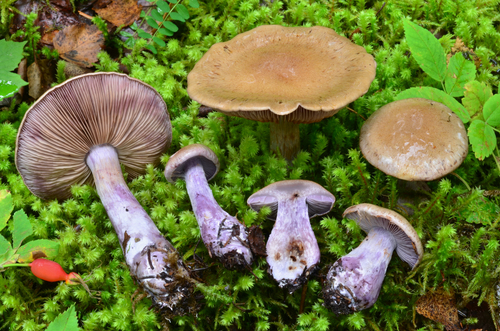
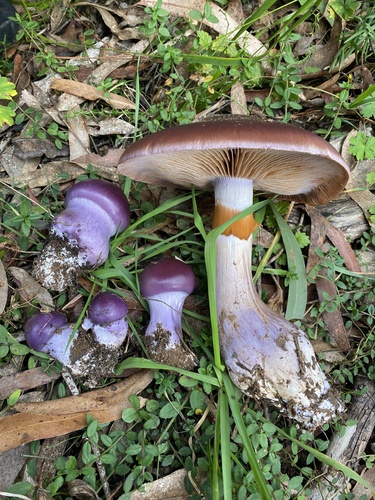
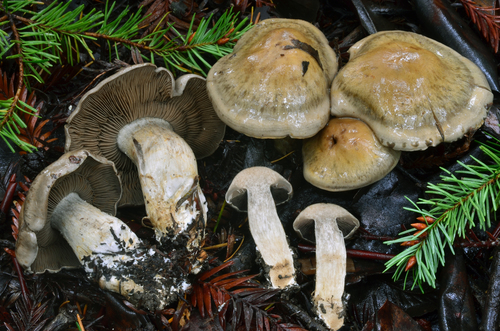
Cortinarius infractus (Pers.) Fr. has caps measuring 4 to 13 cm (1.6 to 5.1 inches) in diameter, which are thickly fleshy, especially at the center. Caps start out convex, becoming slightly undulatingly flattened even when young, then develop into a shape that is convex and depressed around the central umbo, before eventually flattening. They retain a low broad umbo for a long time, but sometimes become uniformly depressed in maturity. The cap margin is distinctly curved, slightly rolled inward when young, and becomes thin and sharply rounded when mature, often appearing wavy and lobed. The cap surface is smooth and sticky, colored dirty yellow-olive to dirty brownish-olive or olive grayish-green, fading to dirty light brown with a green tinge. It has streaky fibrils starting almost from the cap midpoint, with few fibrils at the center, and retains a fine, persistent dark greenish-brownish coloration. The gills range from moderately crowded to widely spaced: mature specimens have about four gills per centimeter at the midpoint, and around ten per centimeter near the margin. They are adnate and deeply emarginate (notched), especially when mature, and grow up to 7 mm (0.28 in) broad. The gill surface is somewhat wrinkled, and the gill edge is either entire or slightly undulatingly denticulate. Gills are colored dirty olive, darkening to dark brownish-olive as they mature, with a slightly paler edge. The spore print of this species is rusty-brown. The stem grows up to 13 cm (5.1 in) long, measuring 2.5 cm (0.98 in) wide at the apex and up to 4 cm (1.6 in) wide at the base, where it thickens into a bulb. The bulb is not sharply defined, marked by a rounded ridge, and is egg-shaped in cross-section. The stem remains solid for a long time, and sometimes becomes hollow with age; it is firm, hard, and silkily fibrillose, colored dirty whitish with an olive tinge and a faint greenish-blue tint, especially at the apex. It sometimes even has a blue tint or bluish spots on the bulb. The cortina is olive greenish when young, turning brownish with age, it is thickly developed but disappears quickly. The flesh is tough when young, becoming softer with age, and is whitish with a slight bluish-green tinge. It is thick in the cap, and has a uniformly soft, juicy texture. Under the stem surface, the flesh is fibrillosely rivulose and colored dirty bluish-green or greenish-olive; the bulb flesh is more uniform and almost non-fibrillose. The taste of this mushroom is bitter, and the odor is faint, similar to radish. The spore-bearing basidia measure 50–60 by 9–10 μm, and each has four 6–7 μm long sterigmata. In 1999, Moser and Ammirati described a variety of this species, Cortinarius infractus var. flavus, that they had observed repeatedly since 1983 in Shoshone National Forest, Wyoming. This variety differs from the typical variety in its cap, which grows up to 8 cm (3.1 in) and has a yellow-brown to almost yellow color. It also has paler gills described as "olivaceous-brownish", and a slightly bitterish, sometimes mild taste. Fruit bodies of Cortinarius infractus grow scattered in deciduous forests containing both oak and beech.