About Cortinarius cinnamomeus (L.) Gray
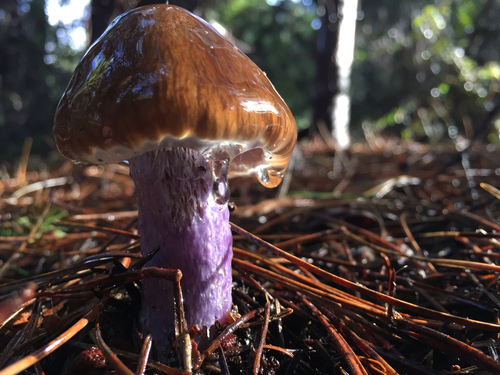
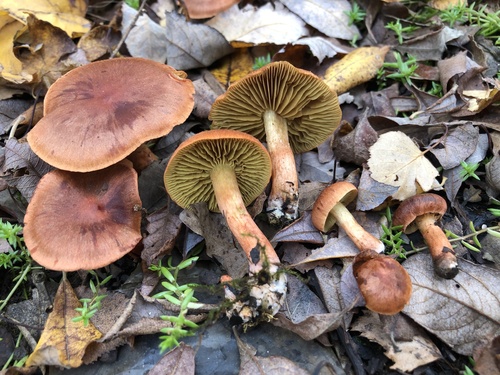
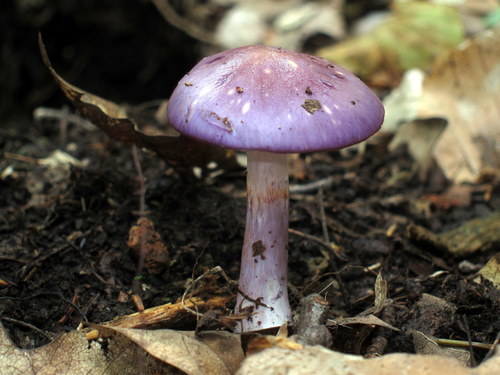
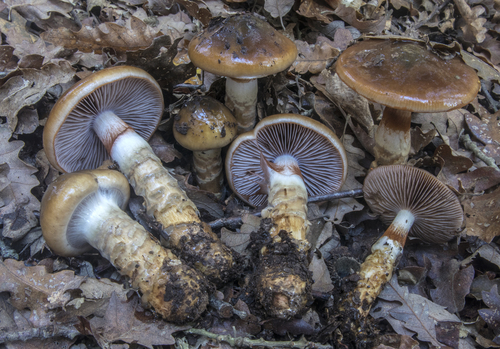
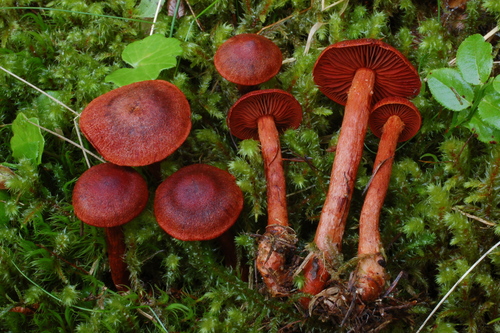
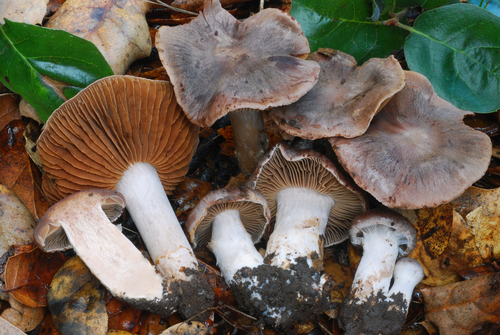
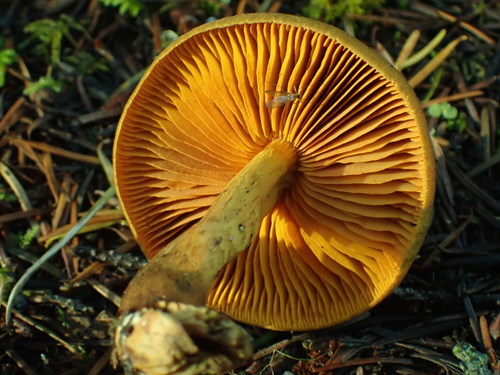
Cortinarius cinnamomeus (L.) Gray has a cap that is thinly fleshy, 3–6 cm (1+1⁄4–2+1⁄4 in) in diameter. Young caps are quite spherical, while mature caps become bluntly convex to bell-shaped, most with an umbo, and are often irregular, bent or wavy near the margin. The cap margin curves inward initially, then straightens; the margin itself is sometimes slightly flexuosely rugose, or even briefly fimbriate. The cap surface is dry, opaque, and ranges from fibrillosely squamulose to tomentose. When young, it is vivid yellow ochre, yellow, or copper olivaceous, becoming glabrescent or fully glabrous as it matures. Mature caps are brownish olive or light olive, often with a saffron tint at the margin; young caps have numerous universal veil fibrils, and mature margins are mostly the same color as the rest of the cap. The gills are tightly crowded, 3–5 mm (1⁄8–1⁄4 in) broad, emarginate (notched), and adnate by a small tooth. Young gills are vivid yellow, maturing to brownish-olive, rarely with a saffron tint, and finally becoming brownish-olive to rusty cinnamon. The gill edge is denticulate (finely toothed), and matches the gill color or is paler. Young specimens have a yellow cortina of fine fibers that stretches from the cap to the stem. The stem is 8–12 cm (3+1⁄4–4+3⁄4 in) tall and 0.5–1 cm (1⁄4–1⁄2 in) wide, cylindrical, often slightly wavy. It is solid when young, becoming hollow, fibrillose, and quite fragile. Young stems are nearly the same color as young gills, vivid yellow, turning yellow with more or less of an olive tone as it ages, and developing brown patches in places. The stem is covered with veil fibrils that form one or two incomplete, oblique, usually fugacious colored zones. The flesh is thin; cap flesh is pale yellow or yellow with olive tones, while stem flesh is a little darker, ranging from yellow to olive. It has a faint, slightly radish-like smell and a mild taste. The spore-bearing basidia are 20–30 by 5–8 μm. Spores are elliptical with a slightly roughened surface, measuring 6–9.5 by 4–5 μm, and the spore print is rusty-brown. Fruit bodies are common in damp areas of coniferous forests, occurring across Europe and apparently throughout the temperate zone of the Northern Hemisphere. It has also been collected in Yunnan Province, China. This species colonizes the root systems of the sedges Carex flacca and Carex pilulifera, forming ectomycorrhizal-like structures that lack a Hartig net, the network of hyphae that grows between the epidermal and cortical root cells. These structures formed between C. cinnamomeus and the sedges have a distinct 85–100 μm thick fungal mantle, hyphal infection in epidermal cells, rhizomorphs, and extramatrical hyphae. These ectomycorrhiza-like structures grow on first-order lateral roots, and are morphologically and anatomically distinct from dauciform roots (short, swollen, hairy lateral roots). Fruit bodies of this species are used in mushroom dyeing to produce a brown color. While it has been reported to be edible, it can resemble some deadly poisonous species.