About Cortinarius caperatus (Pers.) Fr.
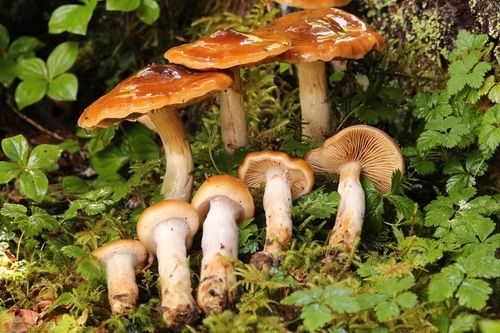
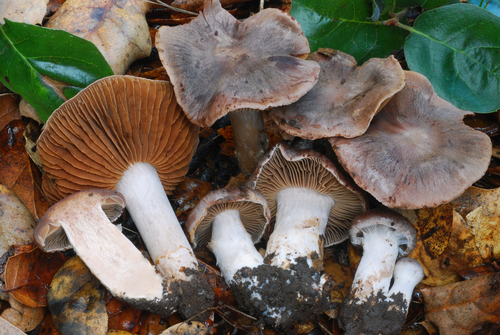
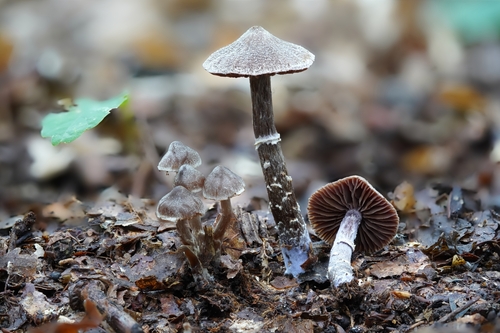
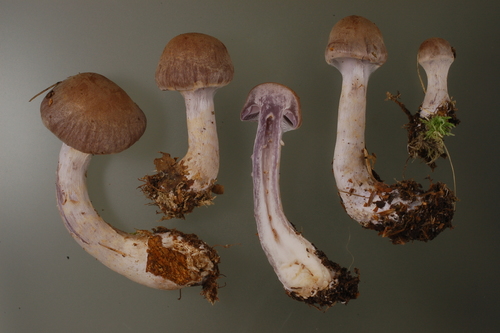
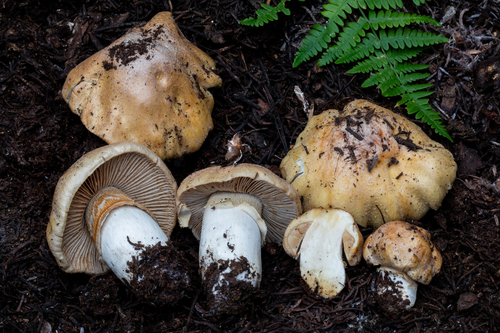
Cortinarius caperatus has a buff to brownish-ochre cap that measures 5–12 centimetres (2–4+3⁄4 inches) in diameter. The cap is covered in whitish fibres, and has a wrinkled, furrowed surface texture. Young specimens may have a lilac tinge on the cap. The cap starts out convex before expanding and flattening, retaining a raised central boss called an umbo. The stipe is 4–12 cm (1+1⁄2–4+3⁄4 in) long and 1–2.2 cm (1⁄2–3⁄4 in) thick. It is slightly swollen at the base, whitish to beige, and has a prominent whitish ring that was initially attached to the cap when young. The partial veil is a key identifying feature of this mushroom. Spores produce an ochre-brown spore print. The spores themselves are warty and almond-shaped, measuring 10–13 μm long by 8–9 μm wide. The mushroom's flesh is cream-coloured, and it has a mild flavour. This species is found across northern Europe; it is mainly common in Scandinavia, but uncommon in Denmark and Iceland. In the British Isles, it is uncommon outside the Scottish Highlands and the New Forest. It is classified as vulnerable in Germany and Great Britain, and endangered in the Netherlands. In the area around Salzburg, Austria, it became less common between 1937 and 1988, a change thought to be caused by picking. It is widely distributed across northern parts of North America, ranging as far south as Mendocino County on the west coast, and is uncommon in California. It is a rare species in the subarctic areas of western Greenland. C. caperatus also grows in temperate Asia; it has been recorded growing with bilberry near oriental beech (Fagus orientalis) and with fir near Pamukova in the Marmara Region of Turkey, and grows in boggy areas of the taiga (boreal pine forest) of western Siberia. It is a mycorrhizal species that is non-selective in its host plants. Fruiting bodies emerge from August to October in conifer and beech woods, as well as in heather habitat—often close to sphagnum moss—in Scotland. In North America, mushrooms appear from September to November, while in Alaska they appear in July and August. It prefers acidic, sandy soils and avoids chalky soils, and may grow in the same habitats as bay bolete (Imleria badia), brown roll-rim (Paxillus involutus), and chanterelles. It forms mycorrhizal relationships with Scots pine (Pinus sylvestris), and is often found under Sitka spruce (Picea sitchensis) or near huckleberry in North America. In Alaska, it grows with dwarf birch (Betula nana) and American dwarf birch (Betula glandulosa). In Greenland, it grows in association with white birch (Betula pubescens).