About Cortinarius anomalus (Fr.) Fr.
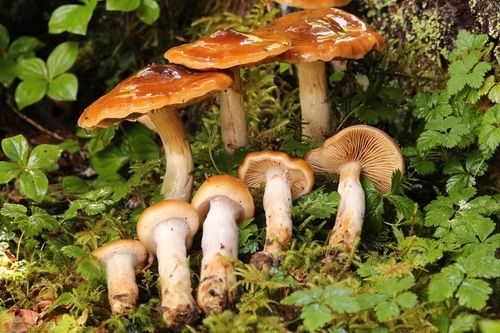
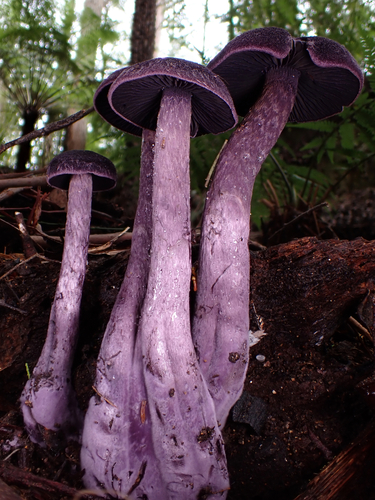
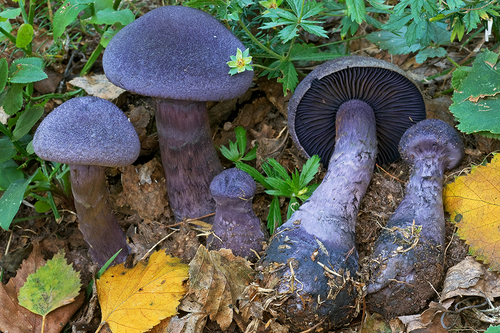
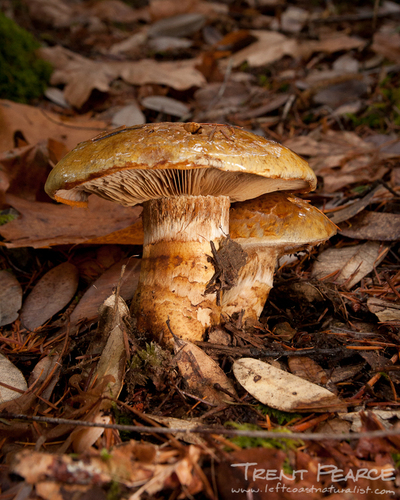
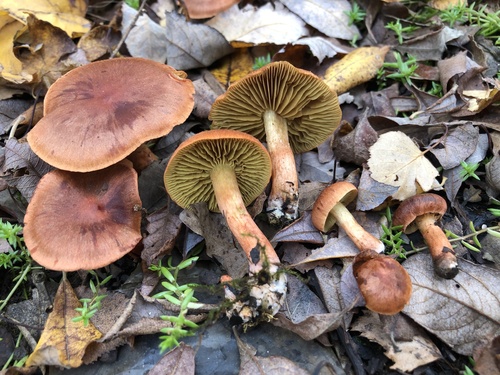
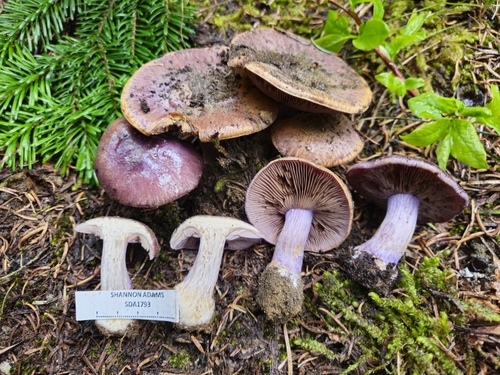
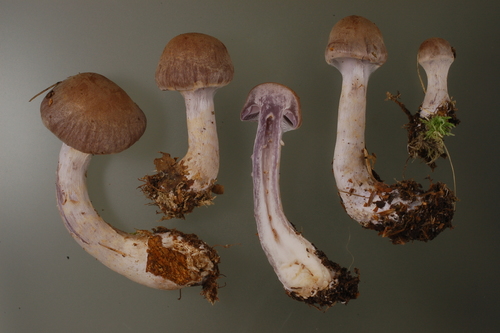
The cap of Cortinarius anomalus (Fr.) Fr. can reach up to 5 cm (2 in) wide. It starts out almost spherical, expands into a convex shape, and finally becomes flattened. The cap has a broad, blunt, low umbo, which often sits in a depression, because the cap margin, initially rolled inward, later straightens and frequently turns upward. The cap cuticle is dry and hard to peel. The cap surface is either dry or humid, non-shiny at the center, and shiny towards the margin, which is covered in fibrils when the mushroom is young. The cap is almost uniformly colored dirty rusty-brown, ashy-brown, or grayish-tan; it is sometimes slightly paler toward the margin, and may have a faint grayish-violet tinge when young, or lack this tinge entirely. The gills are moderately spaced, around 4 mm (3⁄16 in) wide when mature, and thin. When young, they are whitish-blue, grayish-blue, or pale lilac. As the mushroom matures, the gill color fades quickly: it soon turns brown, then rusty-clay, and loses all trace of the blue color found in young specimens. The gills attach to the stem in an adnate (fused to the stem) and emarginate (notched) arrangement. The gill edge is pale, and ranges from very finely toothed to straight. The stem is 6–8 cm (2+3⁄8–3+1⁄8 in) long and 0.5–0.8 cm (3⁄16–5⁄16 in) thick. It is cylindrical in its upper section, slightly club-shaped toward the base, and usually somewhat curved. When young, it is heavily covered in fibrils; as it ages, it becomes silvery shiny and wavy. When young, the apex of the stem is violet or grayish violet, and the base is more gray or grayish-brown. The violet coloring fades quickly, leaving the stem whitish or pale clay brown with silky fibrils. There is a golden yellow ring-like region just below the cap. In other areas of the stem, remnants of the partial veil sometimes appear as yellowish-saffron hairy tufts that form incomplete rings or scattered tiny scales. The cortina, a cobweb-like partial veil made of silky fibrils, is thick and whitish, and only lasts a short time. The flesh of the cap is thin, rarely thicker than 0.5 cm (3⁄16 in). When young, it is whitish to pale violet or pale lilac in the upper section of the stem, but this color fades quickly; in the lower section of the stem, the flesh is grayish-white. The mushroom has a faint fruity smell and a mild taste. It is classified as inedible. The spore deposit is rusty-brown. Spores range from spherical to egg-shaped, with a distinct apiculus (the part of a spore that attaches to the sterigmata at the end of a basidium). They are finely verrucose, and measure 5.7–9 by 7–8.5 μm. The four-spored spore-bearing basidia measure 30–40 by 8–9 μm. Cortinarius anomalus is a common mushroom that grows in deciduous, mixed, or more rarely coniferous woods. Its fruit bodies appear in late summer and autumn throughout the temperate zone of the Northern Hemisphere.