About Correa lawrenceana Hook.
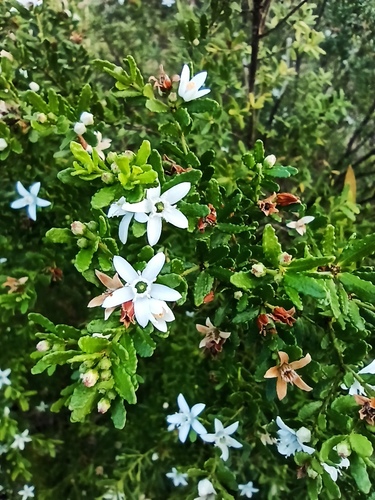
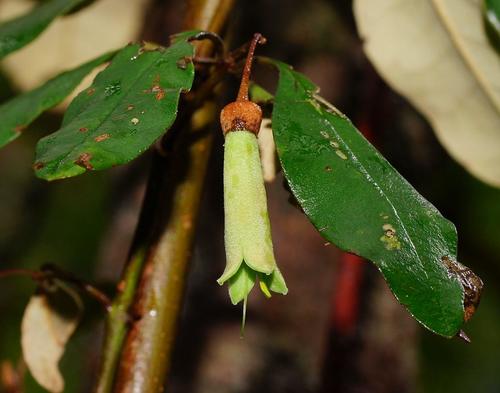
Correa lawrenceana Hook. is most commonly a shrub that typically reaches 0.6 to 9 meters (2 feet 0 inches to 29 feet 6 inches) in height, and sometimes grows as a tree up to 16 meters (52 feet) tall. Its branchlets are covered in rusty hairs. The species produces leaves arranged in opposite pairs, shaped elliptical to egg-shaped, measuring 13 to 120 millimeters (0.51 to 4.72 inches) long and 7 to 70 millimeters (0.28 to 2.76 inches) wide, attached by a petiole that grows up to 16 millimeters (0.63 inches) long. Flowers are arranged singly or in groups of up to seven in leaf axils, and rarely appear on the ends of branchlets. Each flower sits on a pedicel 5 to 50 millimeters (0.20 to 1.97 inches) long. The calyx is hemispherical to cup-shaped, 3 to 10 millimeters (0.12 to 0.39 inches) long and 4 to 6 millimeters (0.16 to 0.24 inches) wide. The corolla is cylindrical, with a color ranging from greenish yellow to red, and a scaly to velvety surface. It is 12 to 50 millimeters (0.47 to 1.97 inches) long, with four short lobes at its end. The stamens project well past the end of the corolla. Flowering occurs in spring, with sporadic flowering at other times. This species grows in rainforest and sclerophyll forest across Tasmania, Victoria, New South Wales, the Australian Capital Territory and Queensland. Several varieties have specific distribution ranges: variety cordifolia grows in forest on the coast and tablelands of southern New South Wales, the Australian Capital Territory and far north-eastern Victoria; variety genoensis is only known from the banks of the Genoa River near the New South Wales-Victoria border; variety glandulifera occurs in the mountains from the Gibraltar Range in New South Wales to the McPherson Range in south-eastern Queensland; variety grampiana grows among rocks in mountain areas, mainly in the Grampians; variety latrobeana is found in south-eastern New South Wales and eastern Victoria; variety lawrenceana occurs in mountainous areas in Tasmania and the Australian Capital Territory; var. macrocalyx grows in mountainous areas between the Taree and Illawarra regions in New South Wales; and var. rosea is only found in the Snowy Mountains of New South Wales. The flowers of Correa lawrenceana are presumed to be pollinated by either birds or bees. In horticulture, this species is suited to cool, moist, partly shaded positions, and is known to tolerate frost and snow. It can be used as a screening plant, and will attract honeyeaters to gardens. Plants propagate easily from cuttings, while propagation from seed can be difficult.