About Correa backhouseana Hook.
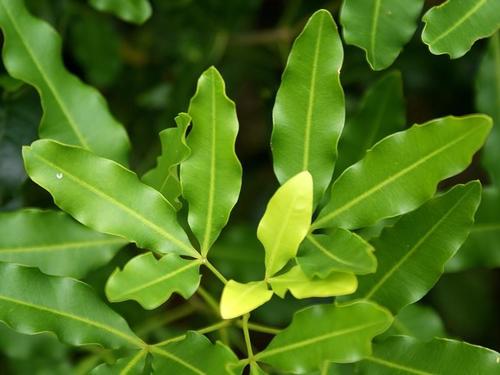
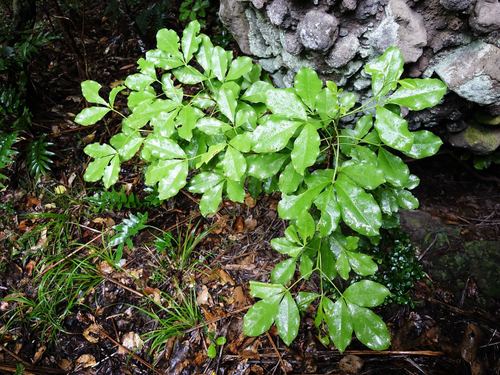
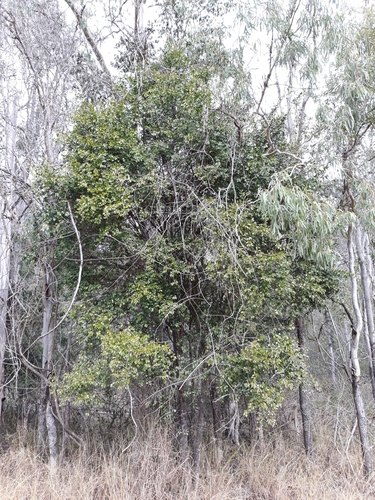
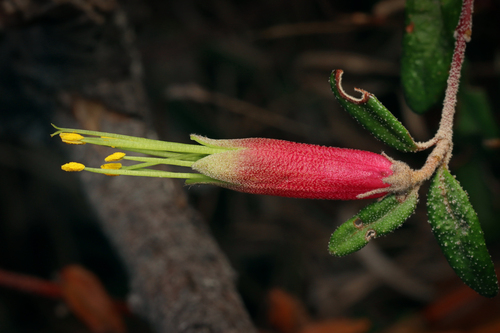
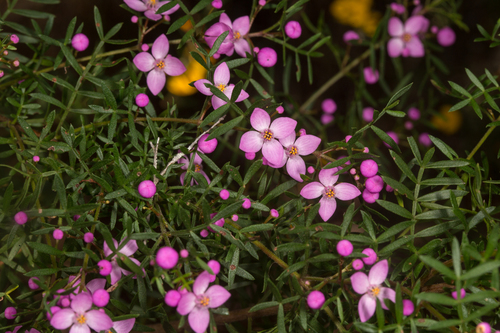
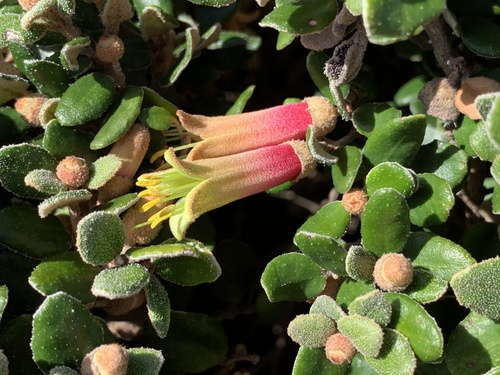
Correa backhouseana is a rounded shrub that typically reaches 2 metres (6 feet 7 inches) in height. Its young branchlets are covered in woolly, rust-coloured hairs. The leaves are leathery, ranging in shape from elliptical to egg-shaped, or roughly round. Most leaves are 15–25 millimetres (0.59–0.98 inches) long, borne on a short petiole. The upper leaf surface is roughly hairless, while the lower surface is densely covered in woolly hairs. Flowers grow singly or in groups of two or three on short side shoots, and are usually pendent. The calyx is hemispherical, 2–7 millimetres (0.079–0.276 inches) high, and densely covered in woolly hairs. Petals range in colour from cream to pale green, or red and yellow, and are 15–25 millimetres (0.59–0.98 inches) long. They form a cylindrical or funnel-shaped corolla, and the eight stamens are slightly longer than the corolla. This correa grows in Western Australia, South Australia, Victoria and Tasmania. Varieties differ in their distribution and habitat: variety backhouseana usually grows on coastal dunes and among rocky coastal areas in Tasmania, the Bass Strait Islands, and near Cape Otway in coastal Victoria. Variety coriacea grows on dunes and granite outcrops west of the Mount Lofty Ranges in South Australia, and on limestone escarpments along the south-eastern coast of Western Australia. Variety orbicularis is endemic to Kangaroo Island in South Australia, where it grows in coastal heath on sand, often over limestone. Correa backhouseana is a hardy plant that tolerates temperatures as low as −5 °C (23 °F). It works well as a screening plant, planted along fencelines, or grown as a container plant. Its flowers and foliage can also be used in floral arrangements. It prefers a position with partial shade, and tolerates salt-laden winds and frost. The cultivar Correa backhouseana var. coriacea 'Eucla Gold' has smaller, narrower, more brightly coloured flowers than the typical variety. It was selected from a wild population near Eucla, Western Australia, and brought into cultivation in Victoria in 1988. Correa backhouseana has earned the Royal Horticultural Society's Award of Garden Merit. In the United Kingdom, it requires a sheltered location and some winter protection.