About Cornicularia normoerica (Gunnerus) Du Rietz
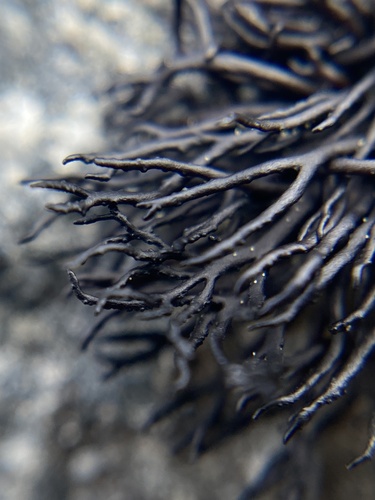
The genus Cornicularia contains only one species: Cornicularia normoerica. This lichen forms compact dark tufts that rarely grow taller than 2 cm. Its entire body, called a thallus, grows upright and anchors so tightly to its substrate that it must be cut or scraped away from rock or bark. Its main branches are narrow, measuring roughly 0.3–0.6 mm across. They are stiff, slightly flattened, and produce very few side-branches. Each branch tapers sharply near its tip, and all branches grow from a repeatedly dividing holdfast, which gives the entire tuft a shrubby shape. The thallus surface is glossy black-brown, covered by an unusually thick outer cortex (outer skin) constructed from densely packed, parallel hyphae. Inside the thallus, the fungal partner hosts rounded green algal cells from the genus Trebouxia; these algae produce sugar via photosynthesis to feed the whole lichen. Reproduction in C. normoerica is primarily sexual. Most branch tips bear black, shiny disc-shaped structures called apothecia, which are 1 to 5 millimetres wide. These discs may grow a small number of short, rod-like extensions, and they gradually extend past the tip of the branch they grow on. Each spore-containing sac, called an ascus, is club-shaped with a thickened tip, and releases eight smooth, colourless ascospores that measure approximately 5–6 × 3–4 μm. This species also produces asexual reproductive structures: half-sunken, spherical pycnidia dot the ends of branches, and secrete thread-shaped conidia roughly 6.5–7.5 μm long. No secondary lichen metabolites have been detected via chemical analysis, a trait that separates this species from many other shrubby lichens in the family Parmeliaceae. The combination of firmly attached sparsely branched tufts, abundant apothecia at branch tips, and no detectable lichen products are key features used to identify C. normoerica in the field. Ecologically, Cornicularia normoerica is a saxicolous, or rock-dwelling, species that grows on sun-exposed rocks and boulders at high elevations.