About Coreopsis tinctoria Nutt.
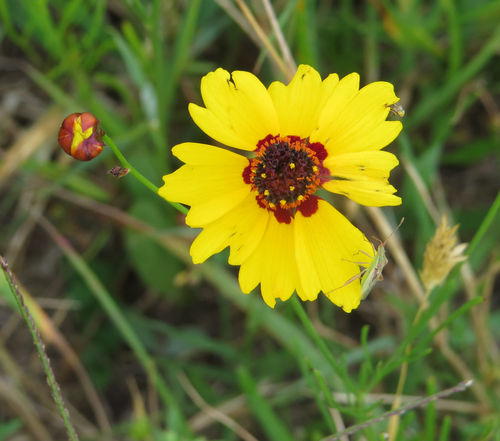
Coreopsis tinctoria Nutt. is a fast-growing plant that reaches heights of 30–100 cm (12–40 in). Its leaves are pinnately divided and glabrous, and become sparser toward the top of the plant, where numerous 25–40 mm (1–1+1⁄2 in) flower heads grow on slender stems. The ray florets of these flower heads have notched tips, and the heads are a brilliant yellow with maroon or brown disc florets of varying sizes. Flowering typically occurs in mid-summer. Its small, slender seeds can germinate in fall (overwintering as a low rosette) or early spring. Coreopsis tinctoria is native to most of the central United States. Within North America, it is considered an introduced species in the western and eastern United States and eastern Canada. It is widely grown in residential and commercial settings, has become naturalized in China, has been recorded as introduced across most of Europe, parts of Asia, and in Mozambique. In its native range, this species typically grows in moist, sandy or clay soil in habitats including prairies, savannas, and plains, at elevations from 0 to 2,000 m (0–6,562 ft) above sea level. It readily colonizes human-disturbed areas such as roadsides, ditches, and agricultural pastures. A wide variety of insects pollinate Coreopsis tinctoria, including long-tongued bees, short-tongued bees, wasps, flies, butterflies, and beetles. It also acts as a larval host plant for multiple insect species, including Synchlora aerata, Tornos scolopacinarius, and Calligrapha californica. The Zuni people traditionally use the blossoms of the tinctoria variety of this species to produce a mahogany red dye for yarn, and made a hot beverage from these blossoms until coffee was introduced by traders. Zuni women also used an infusion of the whole plant (excluding the root) of this variety when they wanted to have a female child. Coreopsis tinctoria, commonly called plains coreopsis, is cultivated as an ornamental garden plant, and is also used as a native plant for wildlife gardens and natural landscaping. It grows well in many soil types, but prefers sandy or well-drained loam soils. While it is somewhat drought-tolerant, naturally occurring populations are usually found in areas with regular rainfall. It prefers full sun, but can also grow in partial shade. Though plains coreopsis is often classified as an annual, some plants behave more like biennials, growing larger and producing more blooms in their second year. Due to its easy cultivation requirements and bright, showy flowers produced by cultivars such as 'Roulette', which has gold tiger stripes on a deep mahogany base, plains coreopsis is increasingly used for landscape beautification and in flower gardens.