About Coreopsis gigantea (Kellogg) H.M.Hall
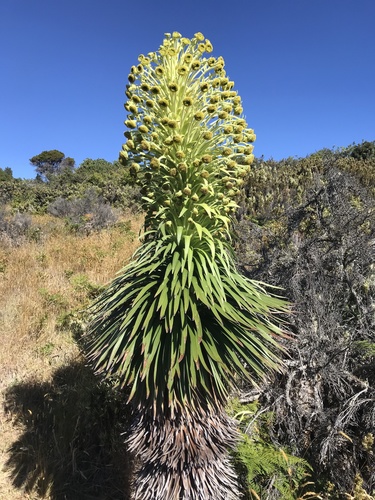
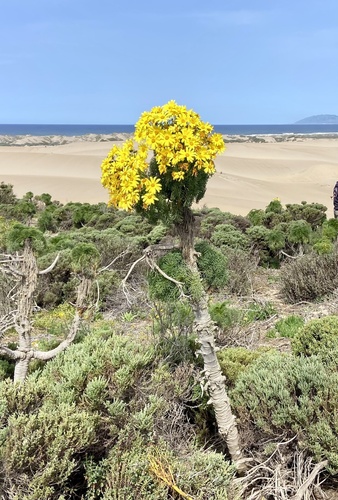
This species is currently accepted under the scientific name Coreopsis gigantea (Kellogg) H.M.Hall, and it was previously classified as Leptosyne gigantea. Its trunk-like stem can grow up to 1 metre (3+1⁄2 feet) tall and 4–10 centimetres (1+1⁄2–4 inches) in diameter. Mature plants reach up to 3 m (10 ft) high and 0.61 m (2 ft) wide. It is summer deciduous, meaning it loses its aboveground growth during the dry season, leaving a sculptural bare trunk and branches behind. Bright green leaves and flowers grow only at the top of the trunk, while the rest of the trunk remains bare. Its leaves can reach up to 30 cm (12 in) in length. The plant produces numerous yellow, daisy-like flower heads that measure 6–20 cm (2+1⁄2–8 in) in diameter, and it blooms from spring through early summer. A related species, Leptosyne maritima, grows in similar habitats. This plant occurs in California coastal sage and chaparral habitats at elevations between 14–55 m (45–180 ft). It grows in coastal dunes, chaparral hillsides, and exposed sea bluff habitats. Its native distribution spans the California coast including Southern California, the Channel Islands, the Central Coast region, and the San Francisco Bay Area, as well as the northwestern Baja California Peninsula and Guadalupe Island in Mexico. Because its stem is succulent, the species is restricted to nearly frost-free habitats, and it can only tolerate cold temperatures down to around 25 °F (−4 °C). Storing water in its succulent stem gives the plant drought tolerance, but makes it particularly sensitive to frost damage. Giant coreopsis is cultivated as an ornamental plant by specialty nurseries. It is planted in native plant gardens, drought-tolerant gardens, wildlife gardens, natural landscaping projects, and habitat restoration projects. It requires good drainage, cannot tolerate excess moisture, and needs only minimal watering during the summer months.