About Coreopsis basalis (Otto & A.Dietr.) S.F.Blake
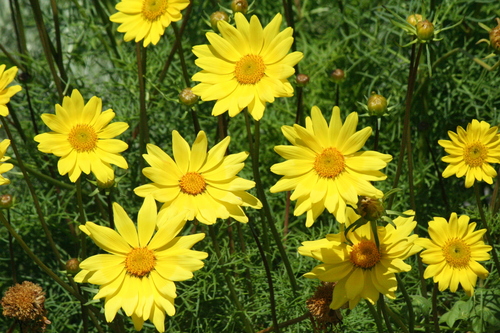
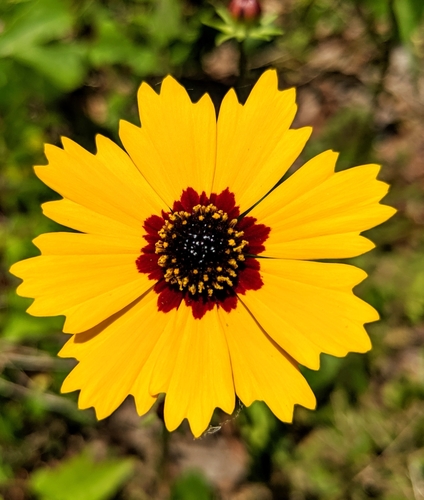
Coreopsis basalis is an annual bushy plant that can grow up to 60 cm (2 feet) tall. It has finely cut foliage and showy round flower heads. Internodes measure 4–7(–10) cm long, and the species produces both basal and cauline leaves. Foliage grows along the bottom 3/4–7/8 of the plant’s total height. Leaf petioles are 8–35 mm long, and may sometimes reach over 120 mm long. Most basal leaves have simple leaf blades, while some develop a few pinnate lobes. Cauline leaves are typically divided into rounded lobes, with 3 to 9 or more lobes per leaf. Simple leaf blades, or the terminal lobes of lobed leaves, vary in shape from elliptic or lanceolate to oblanceolate or linear. Leaf blades are typically 25–55 or more mm long and 2–9 mm wide; the species is variable, so blade width can range from 1 to 20 mm overall. Peduncles that hold the flower heads are 6–15 or more cm long. Phylaries, the bracts located underneath the flower heads, are lance-ovate and 7–9 or more mm long. Ray florets are 15–20 or more mm long, bright yellow, and have reddish markings near where they attach to the flower head. Disc corollas measure 3–4 mm long, and their apices are red-brown to purple. The one-seeded fruits, called cypselae, that develop after fertilization are 1.2–1.8 mm long. They are wingless, but their margins typically curve inwards. Coreopsis basalis grows in sandy soils in open areas, and is often found on disturbed ground. Its range is expanding in the eastern United States, as the species is commonly used in landscaping.