About Corema album (L.) D.Don
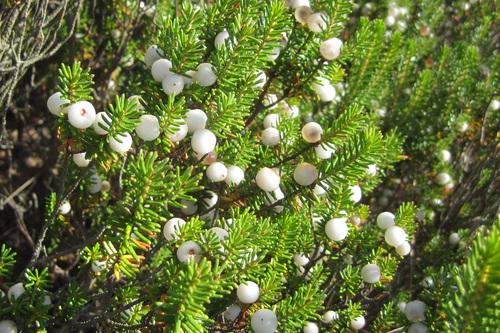
Corema album (L.) D.Don is a dioecious perennial shrub that produces many branches. It usually grows 30–75 cm tall, though it can reach up to 1 meter in both height and width. Male plants tend to grow more upright, while female plants have shorter, more procumbent branches. Its leaves grow in whorls of three or four, with short petioles that typically lie against the stem. The leaves measure 8–10 mm long by 1 mm wide, and are covered in sessile glands when young. Like other members of the Ericaceae family, it has thick, spreading roots. While the species is generally dioecious, some plants from the southwest of the Iberian Peninsula produce both hermaphrodite and male inflorescences. Fruits that develop from hermaphrodite flowers are often underdeveloped. Fruits form along the middle of branches, as the plant’s terminal bud continues growing after fruit set. Female flowers are smaller than male flowers. The fruits are white or pink-white berry-like drupes, 5–8 mm in diameter, that contain 2 to 9 pyrenes. When fully ripe, the fruits are completely white, edible, and have a tough skin. Their flavor is mildly acidic, with a distinct lemony taste. Corema album’s active growth period runs from late February to July, with the most growth occurring in late spring. It flowers primarily between January and April. Fruits ripen from June to July in the southern part of its range, and from August to September in the north, and remain on the plant from October through December. Plants of this genus are thought to have a lifespan of 25 to 35 years. There are two subspecies of Corema album, each with a fully separate native distribution. C. album subsp. album is native to coastal sand dunes of Atlantic Iberia and Aquitaine in southwestern France. Its range extends from Galicia and the Cíes Islands in the north, along the entire Portuguese coast, and south to the Province of Cádiz, Spain. It is especially common in secondary dunes and dune valleys, where it often forms distinct extreme plant communities. C. album subsp. azoricum grows in volcanic lava and ash fields, and occurs on five or six of the nine Azores islands, most often at low altitudes below 200 m. Large populations of C. album are found in three major dune systems: Aspeillo in Spain’s Doñana National Park, the coastal stretch from Sines to Tróia around Comporta in southwestern Portugal, and the Costa de Prata in central-northern Portugal between the coastlines of Nazaré and Ovar. The species is particularly abundant at Praia do Pedrógão, Leiria. Disjunct populations grow on cliffs and isolated sand dunes across the remainder of the species’ range. Corema album is a drought-adapted Mediterranean shrub that tolerates low soil moisture levels. C. album subsp. album grows mainly in sand dunes, but can also grow on rocky sites and cliffs. It occurs most often in heathland, dwarf scrub, and scrub communities that also include Halimium halimifolium, Cistus libanotis, Rosmarinus officinalis, Lavandula stoechas, Cytisus grandiflorus, Stauracanthus genistoides, Juniperus oxycedrus, and Juniperus phoenicea. In some areas, it is the dominant scrub species alongside Pinus pinea. Corema album has been recorded growing successfully near London, England, and is hardy in USDA hardiness zone 8. Most of its natural native range falls within USDA zone 10, with a portion of the Iberian Peninsula population in zone 9, and the Azores population in zone 11. Seed germination of Corema album improves when fruits are eaten by animals. Most seeds require a 1–2 year dormancy period to germinate, but this requirement can be eliminated by keeping seeds moist. The plant can also be propagated from cuttings.