About Corella willmeriana Herdman, 1898
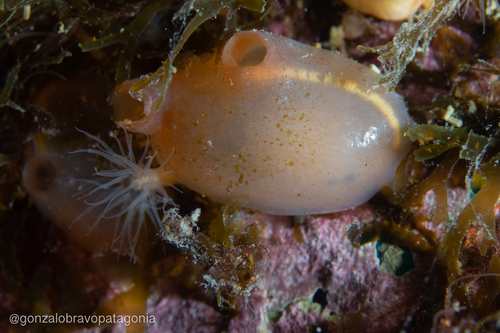
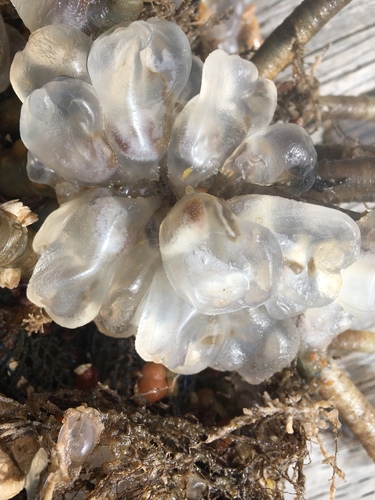
Corella willmeriana is a solitary, sessile tunicate. Its incurrent and excurrent siphons point upward, away from the surface it attaches to. Adult individuals do not have a dorsal nerve cord. For identification, this species is a solitary ascidian that does not reproduce by budding, and individuals are not embedded within a shared common tunic. Individual bodies are usually more than 1 cm in diameter, and the tunic is transparent or translucent. This species attaches to a firm substratum, and its body is typically taller than it is wide. Its oral and atrial siphons are approximately the same length, and the tunic is either smooth or irregularly wrinkled. It may also have a body that is not much taller than wide, with a transparent, colorless tunic; longitudinal muscle bands are not obvious beneath the tunic, and oral and atrial apertures are not carried on distinct siphons. The rectum extends over more than three-quarters of the body height, and the atrium is not expanded into a pocket that broods embryos. This species is found in the Pacific Ocean, ranging from southern Alaska to southern California. It occurs from the subtidal zone down to 75 meters depth, and is often found in fouling communities. It acts as a primary colonizer, because its tadpole larvae show a preference for settling on clean, unfouled surfaces. Corella willmeriana is hermaphroditic, and breeds year-round. Eggs are fertilized inside the atrial chamber, where they develop into free-swimming tadpoles before being released. Swimming larvae stay in the juvenile stage for less than 2 days, before anterior adhesive organs let them attach to a substratum. Attachment triggers metamorphosis, which includes enlargement of the pharynx to allow filter feeding; the notochord is sucked back into the body and is no longer present in the adult form.