About Cordyline pumilio Hook.f.
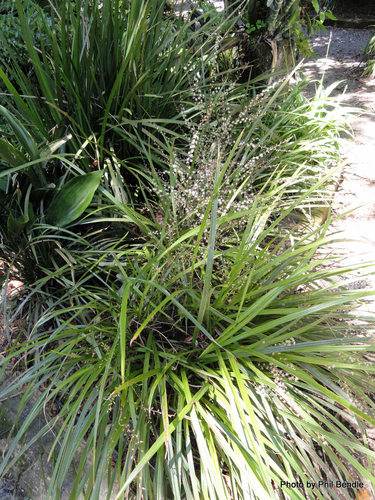
Cordyline pumilio Hook.f. is a plant that rarely grows taller than 2 metres (6.6 feet). It has very narrow leaves, and does not develop into the large tree-like form that C. australis takes. This species often flowers while its short stem remains leafy all the way down to the ground. In older plants, the bare section of the stem can reach up to 1 metre (3.3 feet) long and 1.5 cm (less than an inch) wide, and it is not usually very erect. Its leaves range from 30 cm to 1 metre (1–3 ft) long and 1 to 2 cm (up to an inch) wide; leaves may narrow above the base to form a channelled petiole. The midrib is prominent on the abaxial side, at least in the proximal portion of the leaf, and the leaf margins are slightly recurved. The flower spike or panicle emerges in November or December. It grows up to 60 by 30 cm (1.97 by 0.98 ft), is very open with slender axes, branched to the second order, and bears small white or bluish-white flowers scattered irregularly along its branches. The bracts are often small and inconspicuous. The tepals are narrow, recurved, and have three nerves. The stigma is short and trifid. Cordyline pumilio was cultivated by Māori in the Waikato district and other areas across New Zealand. Māori carefully selected young seedlings to plant out. After approximately three years, the roots were dug up, stacked in small piles, and dried in the sun. As the roots dried, the fibrous roots were burned off; the roots were then scraped and baked slowly in an umu or hāngī, requiring twelve to eighteen hours to cook. The cooked roots were chewed as-is, or they were pounded, washed, and squeezed to extract sugar, which was eaten with fern root as a relish. Māori ranked the taste of this plant above that of tī kōuka (C. australis) and other native New Zealand Cordyline species, but below the taste of tī pore (Cordyline fruticosa), a species Māori brought with them from tropical Polynesia.