About Cordyline manners-suttoniae F.Muell.
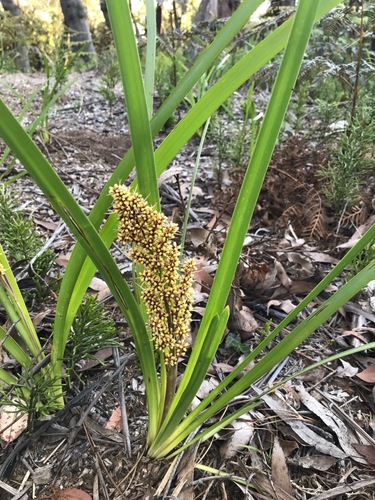
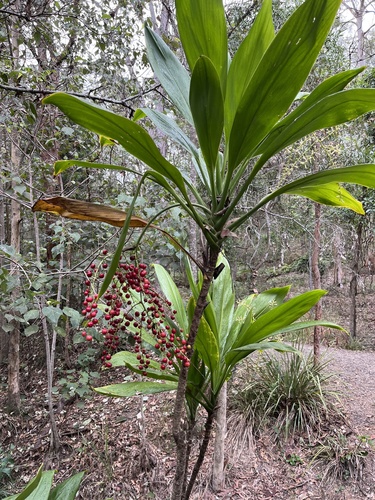
Cordyline manners-suttoniae is an erect shrub that reaches around 4 to 5 m (13 to 16 ft) in height, and may grow with a single stem or develop branches. Its large, simple leaves grow in crowded clusters at the ends of branches, can reach 65 cm (26 in) long and 12 cm (4.7 in) wide, and are arranged in a spiral pattern around the stem. Lateral veins on the leaves run roughly parallel to one another, with numerous smaller secondary veins located between the lateral veins. The fleshy petiole can grow up to 30 cm (12 in) long, has a U-shaped cross-section, and widens at its base to form a sheath that clasps the stem. Inflorescences are panicles that can measure up to 25 cm (9.8 in) long, and are produced either at the end of a growth stem or from leaf axils. The bisexual flowers are around 12 mm (0.47 in) long, with three white or cream petals, and are carried on pedicels around 10 mm (0.39 in) long. Each flower has six stamens, and the ovary is 3-lobed with 2 to 16 ovules per locule. The fruit is a botanically classified berry, bright red and glossy, with a diameter of 8 to 15 mm (0.31 to 0.59 in) that contains up to eight small black seeds. This species, commonly called the giant palm lily, is distributed in eastern Queensland, Australia, from the area around Cooktown south to the area around Rockhampton. It grows in rainforest located in very wet regions, close to swamps, and in areas with poorly drained soils. It occurs at altitudes ranging from near sea level to around 700 m (2,300 ft). The fruit of Cordyline manners-suttoniae is eaten by birds, including the figbird (Sphecotheres vieilloti).